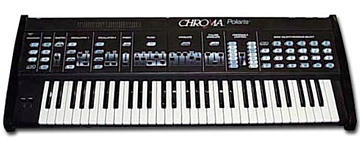
Rhodes Chroma Polaris group photo

Yahoo Groups archive

Rhodes Chroma Polaris

Archive for chromapolaris.

Index last updated: 2026-03-30 01:08 UTC

Thread

More repair tips

More repair tips

2004-09-02 by bkuris

I just finished repairing my 2nd Polaris.

It had pitch instability that varied from voice to voice (detuning
beyond the fairly slow octave beating that is normal) that you
couldn't turn off). One voice was definately broken as the pitch
would slide vs. stepping.

The fix was to replace the S/H capacitors which are the 4 orange caps
on either side of the TL084 opamps near the CEM voice chip.
Replacement caps were panasonic polypropylene caps from
www.digikey.com. I didn't want to take out the motherboard so it
was sort of tricky. You will need a good soldering iron, and
desoldering equipment to clean the pads.

If you notice voice to voice variation (use Lower function - channel
select to isolate voices) you may want to try this repair.


While I was in there, I reinforced the fragile membrane on the
control panel that is between the left and right side PCBS w/hot-melt
glue. Now the PCB bonding provides strain relief. If your panel
*is* working, I suggest you do the same to keep it that way.

Good luck,
Ben

Re: More repair tips

2005-12-14 by tkrotchko

Ah. Now I see what you're talking about. Are these caps referred to
as CX03-X35 and CX02-X27? The service manual refers to them as mylar,
although it shows quantity 25 and 52 of each type.

You also say "be careful not to remove the battery". Can you explain
why? I realize the memory will be lost, but why does it matter?

Also, is there any pictures of the mainboard out there to get an idea
of what I'm up against?

The symptoms that I'm seeing right now is that if I just play right
up the scale, I'll see every few notes just out of tune. And its the
same note every time. Like if I play up the scale, "C" will be out of
tune.

--Tom

--- In chromapolaris@yahoogroups.com, "bkuris" <benjamin.kuris@h...>
wrote:

[...]

> The fix was to replace the S/H capacitors which are the 4 orange caps
> on either side of the TL084 opamps near the CEM voice chip.
> Replacement caps were panasonic polypropylene caps from
> www.digikey.com. I didn't want to take out the motherboard so it

Re: More repair tips

2005-12-14 by bkuris

The battery backup protects also includes trim on VCAs and touch
response of the keys. That info is a pain to recalibrate.

You want to replace the caps labeled Polyprop. that hang off of the
sample/hold latches (ZX01 and ZX02).

The Polaris Mother board is quite large and similar in complexity to
other 80's computers-- the 2nd time I replaced the caps, rather then
remove the board I just added extra solder to the leads of the
existing caps and used reflowed them out carefully. Afterwards I
used a solder sucker to the clean the holes and then carefully
soldered in new caps (with a bit of extra lead to ensure a good
joint). The solder will wick down into the holes.

If you want you can isolate the offending voice(s) to narrow down the
replacement to just a few caps (use voice disable controls) but
sooner or later all will go.

-Ben


--- In chromapolaris@yahoogroups.com, "tkrotchko" <tkrotchko@h...>
wrote:
>
> Ah. Now I see what you're talking about. Are these caps referred to
> as CX03-X35 and CX02-X27? The service manual refers to them as
mylar,
> although it shows quantity 25 and 52 of each type.
>
> You also say "be careful not to remove the battery". Can you
explain
> why? I realize the memory will be lost, but why does it matter?
>
> Also, is there any pictures of the mainboard out there to get an
idea
> of what I'm up against?
>
> The symptoms that I'm seeing right now is that if I just play right
> up the scale, I'll see every few notes just out of tune. And its
the
> same note every time. Like if I play up the scale, "C" will be out
of
> tune.
>
> --Tom
>
> --- In chromapolaris@yahoogroups.com, "bkuris" <benjamin.kuris@h...>
> wrote:
>
> [...]
>
> > The fix was to replace the S/H capacitors which are the 4 orange
caps
> > on either side of the TL084 opamps near the CEM voice chip.
> > Replacement caps were panasonic polypropylene caps from
> > www.digikey.com. I didn't want to take out the motherboard so it
>

Re: More repair tips

2005-12-15 by tkrotchko

Ben,

Thanks so much for that detailed explanation.

It sounds like by leaving the motherboard in, you don't have access to
the trace side, so you just let the solder flow down into the holes.
I would not have thought to do that.

Does removing the MB really add that much time to the repair?

Back to the parts themselves... are the values accurate in the service
manual? You wouldn't happen to have part #'s at digikey would you?

[btw, I just repaired an Apple graphite Wifi basestation. The two
electrolytics in the PS cook themselves after a few years. The board
is multi-layer and it was a real pain to get the solder out of them.
A simple repair that should have been 15 minutes turned into 90
minutes because I had to use a dremel drill to get the solder out.
Apple charged me enough for the base station...couldn't they have
included higher quality caps?]

--- In chromapolaris@yahoogroups.com, "bkuris" <Bkuris@g...> wrote:
>
> The battery backup protects also includes trim on VCAs and touch
> response of the keys. That info is a pain to recalibrate.
>
> You want to replace the caps labeled Polyprop. that hang off of the
> sample/hold latches (ZX01 and ZX02).
>
> The Polaris Mother board is quite large and similar in complexity to
> other 80's computers-- the 2nd time I replaced the caps, rather then
> remove the board I just added extra solder to the leads of the
> existing caps and used reflowed them out carefully. Afterwards I
> used a solder sucker to the clean the holes and then carefully
> soldered in new caps (with a bit of extra lead to ensure a good
> joint). The solder will wick down into the holes.
>
> If you want you can isolate the offending voice(s) to narrow down the
> replacement to just a few caps (use voice disable controls) but
> sooner or later all will go.
>
> -Ben
>