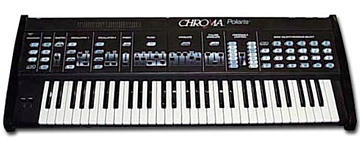
Rhodes Chroma Polaris group photo

Yahoo Groups archive

Rhodes Chroma Polaris

Index last updated: 2026-03-31 23:19 UTC

Thread

Master Tune Membrane Switch

Master Tune Membrane Switch

2007-11-04 by mathroutine

Hello everyone. I am looking to buy a Polaris, I went over to the
owners house and checked out the synth. All the membrane switches
appear to be functioning, with the exception of the master tune button
(the one in the third column from the left). In the manual it said
that the lights would only light up for each voice that was being
tuned, correct? So if the synth is in tune, does the button light up
when it is depressed, or only if it is out of tune? No matter what
other buttons were pressed in combination with it, it would not light
up. Is it broken? The synth itself sounded like it was tuned at the time.

Also, can this function be accessed through an external midi control?
Or does the synth require a repair.

Thanks so much

RE: [chromapolaris] Master Tune Membrane Switch

2007-11-04 by Paul D. DeRocco

> From: mathroutine
>
> Hello everyone. I am looking to buy a Polaris, I went over to
> the owners house and checked out the synth. All the membrane
> switches appear to be functioning, with the exception of the
> master tune button (the one in the third column from the
> left). In the manual it said that the lights would only light
> up for each voice that was being tuned, correct? So if the
> synth is in tune, does the button light up when it is
> depressed, or only if it is out of tune? No matter what other
> buttons were pressed in combination with it, it would not
> light up. Is it broken? The synth itself sounded like it was
> tuned at the time.

You can tell if the problem is the switch or the LED by seeing if the switch
actually does anything. By itself, pressing the switch toggles the function
of the MASTER slider between volume and tuning. If it's the LED, it's an
easy fix, although anything that requires removing the panel boards is a bit
dangerous at this point, since the membrane switch tails might be on the
verge of cracking in a unit this old. If that was the problem and it was my
unit, I'd leave well enough alone. If it's really the switch, though, you
could replace just that switch with a mechanical one.

> Also, can this function be accessed through an external midi
> control? Or does the synth require a repair.

There are System Exclusive messages that can simulate the pressing of
switches. And of course the Tune Request byte does the same thing as LOWER
FUNCTION, TUNE ALL.

--

Ciao, Paul D. DeRocco
Paul mailto:pderocco@...

Re: Master Tune Membrane Switch

2007-11-04 by mathroutine

>
> You can tell if the problem is the switch or the LED by seeing if
the switch
> actually does anything. By itself, pressing the switch toggles the
function
> of the MASTER slider between volume and tuning. If it's the LED, it's an
> easy fix, although anything that requires removing the panel boards
is a bit
> dangerous at this point, since the membrane switch tails might be on the
> verge of cracking in a unit this old. If that was the problem and it
was my
> unit, I'd leave well enough alone. If it's really the switch,
though, you
> could replace just that switch with a mechanical one.
>
> > Also, can this function be accessed through an external midi
> > control? Or does the synth require a repair.
>
> There are System Exclusive messages that can simulate the pressing of
> switches. And of course the Tune Request byte does the same thing as
LOWER
Show quoted textHide quoted text
> FUNCTION, TUNE ALL.
>


Thanks for the reply Paul. How would I go about using a system
exclusive message to simulate the pressing of this switch? Is there
documentation for it somewhere? And what is the tune request byte?

Re: [chromapolaris] Re: Master Tune Membrane Switch

2007-11-04 by David Clarke

>> There are System Exclusive messages that can simulate the pressing
>> of switches. And of course the Tune Request byte does the same
>> thing as LOWER FUNCTION, TUNE ALL.

> Thanks for the reply Paul. How would I go about
> using a system exclusive message to simulate the
> pressing of this switch? Is there documentation for it
> somewhere? And what is the tune request byte?

The MIDI Implementation Manual for the Polaris (available as a link from
the Rhodes Chroma site, Polaris section - here:
http://www.rhodeschroma.com/?id=polaris) outlines what the Polaris can
send/respond to.

The 'Tune Request' is outlined on Page 6.

In summary, there is a standard 'system common message' defined in MIDI
called the Tune Request. If supported, when a card receives this
message it is intended to perform an on-board runing routine.

How you send this will depend somewhat on what you're using to talk to
the Polaris. 0xF6 is the MIDI 'Tune Request' opcode.

In terms of System Exclusive messages for key presses, that's a bit more
involved.

With reference to the MIDI Implementation Manual, you will want to do a
'send message' command.

To confirm that sysex can be received OK by the host, from the Polaris
do a LF-C-12. This should perform a "send main workspace program out
over MIDI." It will do this via a sysex message.

On the host you should see something like:

F0 08 01 4F
30 30 38 35
30 31
F0 08 01 57
32 43 30 30
30 30 46 34
30 30 31 43
30 30 30 30
30 30 30 30
38 30 43 38
41 45 30 36
43 38 31 37
38 36 35 31
30 30 30 30
30 31 30 30
41 30 30 31
46 43 30 44
30 35 46 38
30 31 31 43
38 30 46 46
30 36 30 30
30 39 31 38
30 30 30 30
30 31 30 36
30 30 30 30
31 38 30 36
30 32 37 35
31 46
F0 08 01 53
31 45 30 30
37 46 30 30
F7

Using the MIDI Implementation manual to decode the stream will give you
a good felling for how the Polaris decodes/encodes sysex.

Of this dump, the last portion is the most interest for the original
question.

F0 08 01 53
31 45 30 30
37 46 30 30
F7

Decoding the stream we have:

F0 08 01 = start of sysex, fender ID, channel # (in my case, the MIDI
base channel was '2').

The Polaris uses ASCII strings to represent data - so for the first
message we have:

53 31 45 30 30 37 46 30 30 F7

0x53 = ASCII "S" = Send Message.

A 'send' has the following format:

Sssiimmoo

Where S = ASCII for 'stream'
ss = stream number
ii = instrument number
mm = message
oo = operand

For this example, stream number = 1E (instrument stream) instrument
number = 00
Message = 7F
Operand = 00

In your case where you'd like to change the value of a switch, you'd to
'send' to a stream. Stream 16 is the panel stream.

So that would be:

F0 08 01 53 31 36 30 30 30 43 30 31 F7

Where:

53 = ASCII for "S"
31 36 = stream number "16"
30 30 = instrument number 00 (ignored)
30 43 = "0C" = 'switch press' command
30 31 = "01" = switch #1

So sending this command should 'press' switch #1 (The sequencer 'stop'
button). Changing the switch number (the last two bytes) will allow you
to press any/all buttons on the Polaris.