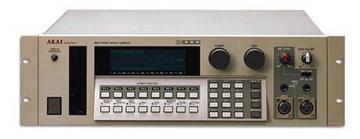
>>>

----- Original Message -----
From: mlcsixand78s
To: akaiS1000S1100Samplers@yahoogroups.com
Sent: Saturday, May 26, 2007 10:11 AM
Subject: [akaiS1000S1100Samplers] Re: New Member (Interested in Mellotron
Samples for S1000 or S2000) Advice Neede


>Hi again,

Hi ... ;-)

>So if I understand right you are saying that the S1100 with its DAs &
>Burr-Browne converters are superior compared to the ones in the S1000,
>S2000 and even the S3000XL?

There\ufffds audible difference in sound in general.
The S-2000 was never my choice because of it\ufffds very reduced user interface
panel, it\ufffds small display in addition and it has stereo outs only in
standard version.

>Also, if I follow what you are saying about polyphonic.... In my case
>I will want to play polyphonic (Mellotron sample chords via midi keys)
>so the S1100 is best for this...?

It was just a example what happens in a sampler if you play more than one
voice and more than one sampler.
Most digital instruments w/ single outs and a stereo out have DA converters
for the stereo out and "multiplex" for the single outs. This is common not
only for samplers.
The bit-depth of the S-series samplers is 16Bit which is also for the
converters.
The bit-depth represents the dynamic range of the instrument, - so, if you
use the stereo out only, it changes nothing if you compare between the
S-series models regarding playing one voice w/ one sample only or more
voices w/ more samples. If you play one voice w/ one stereo-sample, - this
can profit from the full bit-depth of 16 Bits in each of the L and R
channels of the stereo out \ufffdcause the sampler has 2 16bit converters, one
for the left and one for the right channel.
If you play polyphonic this way, - all the voices/ samples together use this
bit-depth which is quite good if all voices/samples have the same level, -
theoretically best 0dBfs,- if there\ufffds enough headroom at the output !

In real world usage, this might be not the case, -. levels of voices/samples
are been changed by velocity, filtering and different overall levels of
layered samples p.ex. and in such cases, a signal at lower level in a sum of
signals uses less bits ( less than 16 ) compared to other signals in this
sum and that reduces soundquality of the lower level signals at the stereo
out. So, the usage of bit-range depends on the level of any signal if more
than one signal is mixed digitally inside the sampler and running via the
stereo output.

Most samplers have single outs in addition to the stereo out. Therefore it\ufffds
possible to route samples of a program to these single outs (which b.t.w.
are monophonic if analogue filters are used but are polyphonic w/ digital
filters, - depending on brand and type of the sampler ).
If all of these single outs have a dedicated 16Bit converter of high quality
and oversampling in addition to the stereo converter of the stereo output, -
w/ 8 single outs, you\ufffdll get 10 16Bit/44.1 KHz outputs to which 10 (or more)
samples of 16Bit/44.1Khz can be routed at full level  and running to a good
console for mixing/blending samples without any loss of bit-depth by mixing
digitally inside the sampler.
In a recording situation, you\ufffdll get best results that way and w/ the S-1100
which converters themselves have better sonic quality compared to the other
candidates of the S-series samplers.
Think of a drumkit p.ex. w/ every single drum is running out of the single
outs at full scale w/ a mix and panning of only the cymbals at the stereo
output.
The result is most punch and soundquality via the single outs w/ one
converter each.

All above is in general for digital gear and doesn\ufffdt depend on mellotron
sounds.
I pressume, melotron sounds don\ufffdt have a full dynamic and frequency range
which 16Bit/44.1KHz converters w/ oversampling can deliver, - so, eventually
this sound quality isn\ufffdt nesseccary for mellotron sounds, - but I don\ufffdt
think you\ufffdll not only play these.


>Also I seen that what ever sampler I get it would be best to load it
>up with maximum RAM (32MB) to get the most out of the Mellotron
>samples and to be able to play a full Mellotron keyboard.

If the overall volume of samples in any program doesn\ufffdt exceed 32MB, - yes.

>Since the original Mellotron had 36 keys/samples and each tape loop
>was 8 secs long. Then a true Mellotron bank of samples would be 8
>seconds long each and add up to lots of MB if at the max audio
>quality. But it would seem to me for a needed compromise a shorter
>(less that 8 sec) Mellotron sample looped should be
>quite effective (like a 4 sec samples looped to save memory)

Sampling time @44.1 KHz of the S-1000/1000PB/1100 and 2000/3000 series is
368 sec. mono or 184 sec. stereo max.!
36 keys/samples mono \ufffd 8 sec = 288 sec. for a bank of  mono-mellotron
samples, - so you\ufffdre pretty fine w/ 32MB and you can loop the samples at
full length of 8 sec. having 80 sec. of sampling time free for other
purposes.

Frequency range of a mellotron is not wide, - experiment w/ lower
samplingrate of 32 KHz. If it sounds good enough ( can be ! ), - you\ufffdre able
to load several banks of mellotron samples at once, - playing \ufffdem on
different midi-channels and via different outputs.
With S-1100 you can decide using FX and route \ufffdem to the stereo outs only or
to outputs #7 and #8 as a "wet" signal.

If you sample a real mellotron yourself, you\ufffdll have only bandhiss in the
upper end of the frequency range, - reduce this by lowering of SR and save
memory by less unused data. Eventually, record the mellotrons samples to a
audio wave program/editor befor transfer to the S-1xxx, - cut, loop, tune
and process the samples in the sample-editor and save to a SCSI harddrive, -
connect the harddrive w/ prepared samples to the Akai and load the
samples, - then, - make your programs.
Look for S-1100 at ebay ...

hope that helps ...

>Br
>Allan

PeWe
Message
Re: [akaiS1000S1100Samplers] Re: New Member (Interested in Mellotron Samples for S1000 or S2000) Advice Neede
2007-05-26 by PeWe
Attachments
- No local attachments were found for this message.