Yahoo Groups archive

Digital BW, The Print

Index last updated: 2026-04-28 22:56 UTC

Thread

Is it possible to mix Claria colour inks to make a neutral grey ink?

Is it possible to mix Claria colour inks to make a neutral grey ink?

2015-10-02 by nigglefish@...

I was wondering if anyone had experimented with mixing Claria C, M and Y outside of the printer to make a neutral(ish) grey ink. I was thinkig of using the Claria K, the mixed grey and a diluted grey to make a BW inkset. I know poeple have experimented with diluting the Claria K and reported fading problems. From what I can piece together the K is only really stable in the long(ish) term when it is at maximum density. The Epson drivers certainly seem to only use it at high densities. But it seems that the colour inks aren't affected by this weaknes. But I have no idea what the effect of mixing these inks together might be in terms of ink stability in the carts/bottle or print stability. Or in any other terms. Does anyone have any information or experience mixing such a grey ink and diluting it?


Re: [Digital BW] Is it possible to mix Claria colour inks to make a neutral grey ink?

2015-10-02 by Paul Roark

I never tried to make a gray ink by mixing only the colors. I did mix a blended Noritsu K plus magenta (and base) to make a neutral LK.

I stopped the blending approach when I detected (or thought that I detected) a change in a stored bottle that could was consistent with catalytic fade. It was not a major change in the stored ink and could have even been some "operator error," but I was sufficiently convinced of the possibility of yet another negative issue relating to dyes and I abandoned the blended K plus color approach.

I'd guess that it would be nearly impossible to match the current Epson dye K by merely mixing their colors. If they (which probably means Fuji) could make a better K, they would.

Paul


Show quoted textHide quoted text
On Fri, Oct 2, 2015 at 7:41 AM, nigglefish@... [DigitalBlackandWhiteThePrint] <DigitalBlackandWhiteThePrint@yahoogroups.com> wrote:

I was wondering if anyone had experimented with mixing Claria C, M and Y outside of the printer to make a neutral(ish) grey ink. I was thinkig of using the Claria K, the mixed grey and a diluted grey to make a BW inkset. I know poeple have experimented with diluting the Claria K and reported fading problems. From what I can piece together the K is only really stable in the long(ish) term when it is at maximum density. The Epson drivers certainly seem to only use it at high densities. But it seems that the colour inks aren9;t affected by this weaknes. But I have no idea what the effect of mixing these inks together might be in terms of ink stability in the carts/bottle or print stability. Or in any other terms. Does anyone have any information or experience mixing such a grey ink and diluting it?


Re: [Digital BW] Is it possible to mix Claria colour inks to make a neutral grey ink?

2015-10-02 by Ernst Dinkla

Mixing CMY dye inks to get a B&W grey ink is really the worst scenario in terms of longevity. It is already damned difficult to achieve a neutral grey in that mix and then printed on paper, both for changing light conditions. One of the dye ink colors will fade faster than one of the other two so a color shift will happen in time. That time could be short as it is a known issue with dye inks that a mix of them brings forth chemical instability of the colorants or not, hard to say where the Claria CMY dye fits. Diluting the Claria black dye is still a better idea.

Met vriendelijke groet, Ernst

Dinkla Grafische Techniek
Quad, piëzografie, giclée
www.pigment-print.com
Show quoted textHide quoted text
On Fri, Oct 2, 2015 at 4:41 PM, nigglefish@... [DigitalBlackandWhiteThePrint] <DigitalBlackandWhiteThePrint@yahoogroups.com> wrote:

I was wondering if anyone had experimented with mixing Claria C, M and Y outside of the printer to make a neutral(ish) grey ink. I was thinkig of using the Claria K, the mixed grey and a diluted grey to make a BW inkset. I know poeple have experimented with diluting the Claria K and reported fading problems. From what I can piece together the K is only really stable in the long(ish) term when it is at maximum density. The Epson drivers certainly seem to only use it at high densities. But it seems that the colour inks aren't affected by this weaknes. But I have no idea what the effect of mixing these inks together might be in terms of ink stability in the carts/bottle or print stability. Or in any other terms. Does anyone have any information or experience mixing such a grey ink and diluting it?


Re: [Digital BW] Is it possible to mix Claria colour inks to make a neutral grey ink?

2015-10-02 by tyler@...

in my opinion the old Lyson dye quad sets were mixed from their color inks, Metamerism failure was terrible, I worked with them for some time. Trying to make neutral with highly saturated colorants seems problematic to me, not only because neutral will be hard to hit, as Ernst mentions, but the colorants involved will each have their own, more noticable, reactions to lighting conditions. Just my thoughts on why those dyes didn't work well. Surprisingly Wilhelm gave them good longevity marks...

Re: Is it possible to mix Claria colour inks to make a neutral grey ink?

2015-10-08 by nigglefish@...

Thank you everyone for all the information. 

Thank you Paul for sharing your experience. This is exactly what I was asking about and I appreciate you providing me with a search term, 'catalytic fade', to get me started learning some more. I respect your opinion in these matters and even though you are careful to establish that your conclusion may not be founded, I regard even your suspicion as significant.

Thank you, Ernst and tboleyyh, for your feedback regarding colour artefacts when mixing coloured inks to make BW prints. I was really asking about the problems that might occur when mixing inks outside the printer, which largely remain an unknown. But, of course, I am very interested and appreciative of your feedback regarding the use of colour inks for BW printing. In regard to metameric failure and achieving a neutral (enough) print tone, these are things I can experiment with, even with the inks in the default configuration. Paul has suggested that as little as one third K load is sufficient to minimise the colour artefacts for a range of lighting conditions. I find a pretty large range of tones attractive so maybe I can trade 'neutral' for an easier 'pretty'. When I have a functioning printer working again I look forward to experimenting. Perhaps I will end up just using the K in the end.

As for the unknown fade properties of the various colourants that will cause the tone of the print to change over time, Aardenburg fade test results might give some clues. They seem to indicate that while grey patches printed by mixing the coloured inks fade toward blue, those printed using just the K tend toward brown relatively quickly (although by Aardenburg's Conservation Display ratings the K ink alone still scores better). Maybe the two could compliment one another. The best choice, by far, seems to be a good lacquer though.

Paul, you have mentioned in the past that the diluted K exhibited poor fade resistance. Out of curiosity, can I ask if this was significantly worse than a print using just undiluted K (allowing for some neutralising colour)?

Thanks again. If I find the time I'll post with my own experiences, but I probably won't mix a grey outside of the printer until I hear of somebody who has had great success trying it first.
Re: [Digital BW] Re: Is it possible to mix Claria colour inks to make a neutral grey ink?

2015-10-08 by Paul Roark

I never tested diluted Noritsu K against the un-diluted. I assumed dilution can't help the problem.

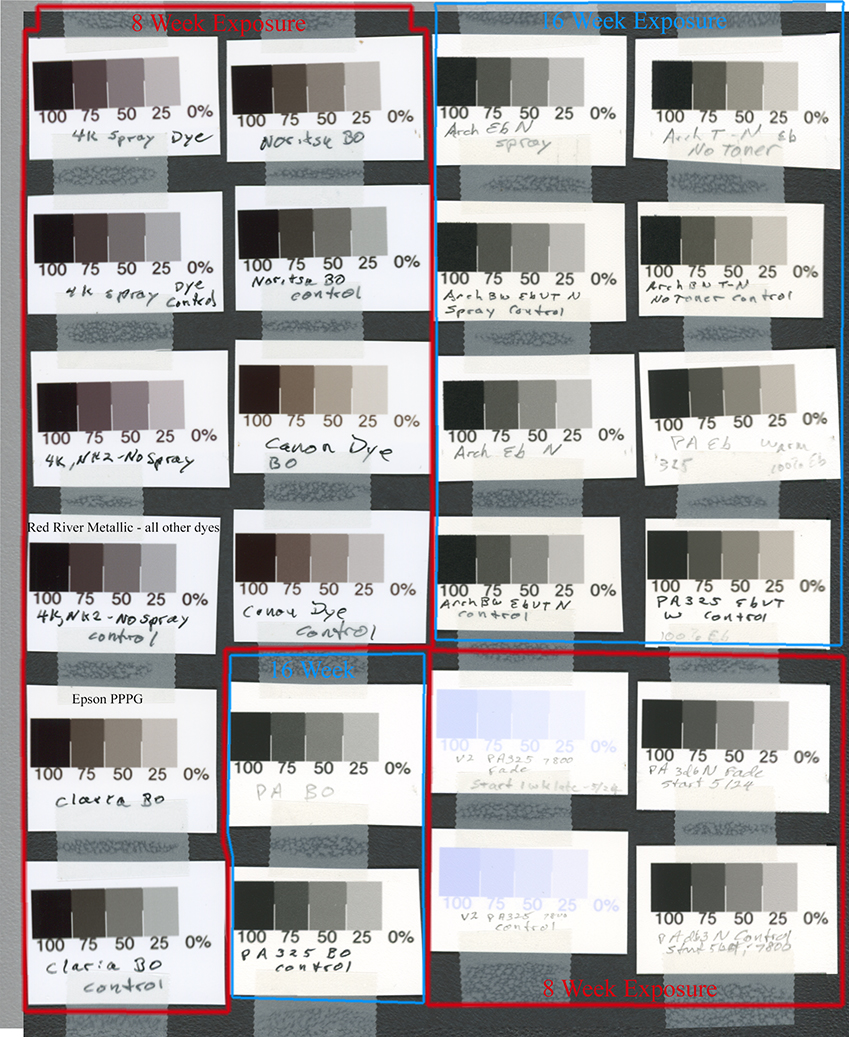
The relative color changes -- based on http://www.aardenburg-imaging.com/ testing -- of the black ink v. the colors is shown at page 3 of http://www.paulroark.com/BW-Info/4000-Noritsu-2K.pdf . My fade test of the two approaches, which is generally consistent with the above information, is posted at http://www.paulroark.com/BW-Info/2nd-8wk-Fade-test-7-26-2015.jpg in the form of a scan of all the test strips and their control (dark storage) strips. The "4K, NK2-No spray" v. the "Noritsu BO" pairs was the main comparison I was interested in. While they don't look much different, the measures of the test patch changes is roughly consistent with the predictions. In particular, Lab B moves down when the dominant inks are the color inks, versus up with the black only. Note that the fade test is roughly equivalent to 50 Mlux-hours of Aai&A or 25 Wilhelm years of display. (See http://www.paulroark.com/BW-Info/Fade-Test-Claria-Roark-v-AaIA-7-2015.pdf)

While with old wet lab color materials the degree of fade we see with these dyes might be considered OK, I don't consider the dyes up to "fine art" B&W standards. (I will be hanging carbon prints under Tru-Vue Museum glass at Gallery Los Olivos on Monday.) The dyes are great for cards and medium term display. The technology also allowed me to mount a very nice show without the cost of mats and glazing, and without the reflections of plain glass or acrylic. Although the dyes don't do very well under fluorescent lights, they generally make a very impressive display.

I used just the diluted K with some LM for a long time making B&W cards, and I never saw any noticeable change in the cards, including some that were intentionally left out on the mantle for over a year. So, I think the dyes have very appropriate uses, but carbon remains the fine art, archival champ by a very large margin.

Paul
Show quoted textHide quoted text
On Thu, Oct 8, 2015 at 1:11 AM, nigglefish@... [DigitalBlackandWhiteThePrint] <DigitalBlackandWhiteThePrint@yahoogroups.com> wrote:

Thank you everyone for all the information.

Thank you Paul for sharing your experience. This is exactly what I was asking about and I appreciate you providing me with a search term, 'catalytic fade', to get me started learning some more. I respect your opinion in these matters and even though you are careful to establish that your conclusion may not be founded, I regard even your suspicion as significant.

Thank you, Ernst and tboleyyh, for your feedback regarding colour artefacts when mixing coloured inks to make BW prints. I was really asking about the problems that might occur when mixing inks outside the printer, which largely remain an unknown. But, of course, I am very interested and appreciative of your feedback regarding the use of colour inks for BW printing. In regard to metameric failure and achieving a neutral (enough) print tone, these are things I can experiment with, even with the inks in the default configuration. Paul has suggested that as little as one third K load is sufficient to minimise the colour artefacts for a range of lighting conditions. I find a pretty large range of tones attractive so maybe I can trade 'neutral' for an easier 'pretty'. When I have a functioning printer working again I look forward to experimenting. Perhaps I will end up just using the K in the end.

As for the unknown fade properties of the various colourants that will cause the tone of the print to change over time, Aardenburg fade test results might give some clues. They seem to indicate that while grey patches printed by mixing the coloured inks fade toward blue, those printed using just the K tend toward brown relatively quickly (although by Aardenburg's Conservation Display ratings the K ink alone still scores better). Maybe the two could compliment one another. The best choice, by far, seems to be a good lacquer though.

Paul, you have mentioned in the past that the diluted K exhibited poor fade resistance. Out of curiosity, can I ask if this was significantly worse than a print using just undiluted K (allowing for some neutralising colour)?

Thanks again. If I find the time I'll post with my own experiences, but I probably won't mix a grey outside of the printer until I hear of somebody who has had great success trying it first.


Move to quarantaine

This moves the raw source file on disk only. The archive index is not changed automatically, so you still need to run a manual refresh afterward.