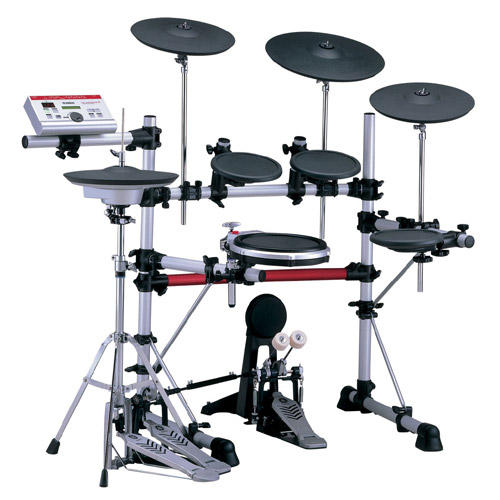
Perry,

If the problem is erotic, the module should take a cold shower, and
the hh and snare should be separated from each other. Apparently the
DTXPII, unlike earlier versions, shipped with default settings that
caused the hh and snare to interfere with each other. Strictly
speaking, if the snare is programmed in the trigger menu to
specifically reject the hh at too high a setting, the snare will
sometimes fail to sound, because rejection essentially mutes a pad
for a micro-second so that it will not react to another pad's hits.
A spec. rej. setting of, say, 9 to protect snare from hh means that
only hits on the snare that register above 9 will voice when the hh
is hit. Since 9 doesn't leave much room for the snare to trigger
even with its own hits when the spec. rej. of the hh takes hold, it
simply shuts down. For more detailed advice, search the posts over
the last few months for "snare and hi hat" or something similar. I
think Yamaha was notified of the problem, and users have been able
to overcome it within the module.

A high gain setting in general will make a trigger more susceptible
to interference, or crosstalk, from other hits on other triggers,
simply because increased gain means increased sensitivity to force--
that is, vibration from elsewhere on the rack can activate it. A low
min. vel. has the same effect; lowering a trigger's min. vel.--the
least force at which it will sound its voice--makes it more likely
to succumb to crosstalk. That doesn't mean that you can't make
relatively sensitive adjustments to these parameters--only that
you'll have to balance them with rejection settings that allow them
to work without crosstalk, or not too much of it (even acoustic
drums and cymbals react to each other a little). Remember, though,
that to reject interference from a pad means to silence that pad
during other events for a moment; it does not do anything to the
offending trigger. You can see why care with rejection is so
important; keep settings only as high as necessary to do the job.
Silencing the pads is hardly what we want to do. It's all a delicate
balance.

It is possible that with certain trigger parameters, and
circumstantial factors like how stable the drum riser or platform
is, live band activity could make your triggers fire a little. You
might have to tell the bass player, for example, to stop bouncing up
and down near your kit. But unless you're shaking like a 25 cent
step ladder, it's more likely that the problem mostly involves the
interaction between the pads. When you're playing in a band
situation, you're probably playing harder, thereby putting a strain
on all your settings.

Ed

--- In DTXpress@yahoogroups.com, psmperry@a... wrote:
> I have been having the same problem with my hi hat and snare. The
snare drops
> out sometimes when I am also playing the hi-hat. Additionally, the
snare
> volume will be erratic, or is that erotic, I'm not sure...but
anyway... could
> you explain what effect adjusting the gain and rejection has on
performance.
> That is, what does lowering or raising these parameters do
exactly. I have
> also noticed the problem is more pronounced when I am playing with
my band.
> Could other electronic sources cause a problem?
>
> perry

--- In DTXpress@yahoogroups.com, psmperry@a... wrote:
> I have been having the same problem with my hi hat and snare. The
snare drops
> out sometimes when I am also playing the hi-hat. Additionally, the
snare
> volume will be erratic, or is that erotic, I'm not sure...but
anyway... could
> you explain what effect adjusting the gain and rejection has on
performance.
> That is, what does lowering or raising these parameters do
exactly. I have
> also noticed the problem is more pronounced when I am playing with
my band.
Show quoted textHide quoted text
> Could other electronic sources cause a problem?
>
> perry