Vern,

Good stuff and points well-taken. On a fairly level playing field,
most of us are not going to hear much difference between 16 bits and
20 bits, depending on the application. But anyone who's followed the
evolution of the CD player from its inception to its current 24
bit/96khz (and considerably higher) incarnation knows that the
change has been dramatic and that the variables in the digital
domain have some importance. CD's earliest hype as "perfect sound
forever" was a complete fiasco, especially when compared to solid
analog performance at the time; CDs started out as cold and harsh.
Somewhere along the line, they began to approximate what midlevel
analog could achieve, but it took time. Even if the difference from
16 to 20 bits isn't audible under ordinary conditions, the
difference between 8 bits or even 16 at 44khz to true 24 bits at
96khz might well be worth pursuing.

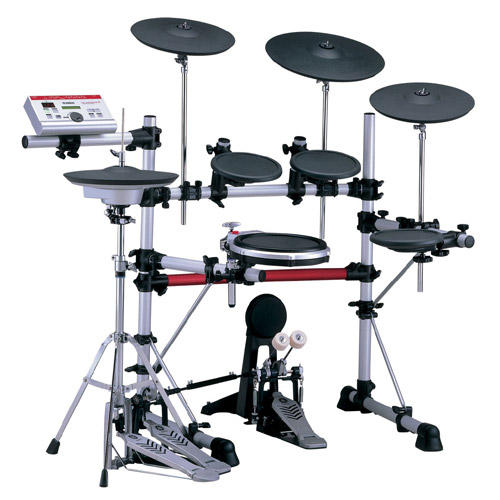
I happen to think that a higher bit width, along with as high a
sampling rate as possible, would be a good thing in drum modules,
assuming that the samples themselves are up to snuff. Cymbals and
drums (especially snares) require a wide frequency response and
dynamic range to sound authentic. An extreme dearth results in the
dreaded machine-gun effect, from which not even the vaunted dtxpress
is totally immune, with its 16 bits and 44khz sampling. On an
acoustic snare, you can roll tightly on the sides of the drum and
get a specific response; at no point does the sound drop out
completely. On an electronic snare, the piezo and its positioning
have a lot to do with the response, but the module contributes much
to the tonality and the faithfulness of the percussive effect. The
better the digital specs, the better are the chances that the sound
will be satisfying. Drummers have a hard-won expectation of drums'
sound according to how and where they hit them. Electronic drums
have moved way past the disappointing stage into the "not bad at
all" stage.

Theoretically, human hearing encompasses from about 20hz to 20khz--
that is, if you're a newborn baby who hasn't been exposed to the
vicissitudes of modern life and the onslaught of age. My decrepit
middle-aged hearing, battered further by 40 years of drumming,
probably taps out at about 14 to 16khz on a good day, and the last
time I tried, I got at least a hint of 20hz, but I still think that
a brick wall DAC at 20 or even 22khz is not heard as natural sound,
with all its ghostly presence, though it's pretty damn good.

Ed

--- In DTXpress@yahoogroups.com, "Vernon Graner" <vern@t...> wrote:
> > Steve,
> >
> > I'd be really surprised if the Xtreme module sampled at a 24 bit
> > rate. I've never seen a number for it, but I always assumed that
it
> > was 16 bit as well. The Alesis DM Pro is the highest that I've
seen--
> > 20 bit--and the DM5 is at 18.
>
> Ok, gunna dust off some old memories here... Prepare to be
> dazed^H^H^H^H^H Dazzled! :)
>
> Sample *width* (i.e. 8 bit, 16 bit) determines the *dynamic range*
of the
> recorded sound. The sample *frequency* (i.e. 11khz, 22khz 44khz)
> determines the *frequency response* of the captured sound. So, a
16 bit
> sample would have less *dynamic range* (distance from noise floor
to
> maximum loudness i.e. ppp->FFF) than a 20 or 24 bit sample.
>
> Some rough examples:
>
> A sample of a cymbal crash done in 8 bit width , 44.1khz sample
rate
> would give you a dynamic resolution of 256 "loudness" levels and
would
> record 22.5 khz as the highest frequency. This would probably
produce a
> reasonably good sounding sample.
>
> So, lets capture the same *amount* of data, but rearrange how we
allocate
> the space by doubling the dynamic range and halving the frequency
> response:
>
> A sample of a cymbal crash done in 16 bit width , 22khz sample
rate would
> give you a dynamic resolution of 64,000 "loudness" levels and would
> record 11 khz as the highest frequency. This would probably
produce a
> very bad sounding sample.
>
> So, lets capture again, but this time boost that 16 bit to 24 bit:
>
> A sample of a cymbal crash done in 24 bit width , 44.1khz sample
rate
> would give you a dynamic resolution of 16,000,000 "loudness"
levels and
> would record 22 khz as the highest frequency. This would probably
produce
> a very good sounding cymbal.
>
> This would result in a similar sounding, but MUCH larger sample
size
> since the amount of data collected would be enormous! Remember,
its a
> combination of the *two* parameters, sample rate and bit depth that
> determine a samples quality. Of course, they in turn determine the
SIZE
> of the stored sample.
>
> As you increase the bit width, you not only increase the amount of
memory
> required to store the sample, you also increase the overhead
required to
> manipulate that data. (i.e. CPU speed, bus width to move the data,
RAM to
> store it in, DAC (Digital to Analog Converters) units to turn the
data
> into sound, etc).
>
> Anyway, where I'm going with this is that you might not see a big
> difference if you auditioned the *same sample* as a 16 bit or as a
24 bit
> sound. In many cases, since they use new samples to make these
kits, it's
> usually not so much the bit width that makes the difference, but
the
> freshness of the samples to your ear. After you've heard the same
samples
> for a number of months from the same old module, oftimes *any* new
sample
> sounds better, even if (from a technical perspective) it's
actually not
> *better*, just different.
>
> From my perspective, I would be hard pressed to determine the
difference
> between a 16 bit and a 20 bit sample, unless I could see the
amount of
> disk space it was consuming.. :)
>
> Vern
>
> PS: I changes the subject line since the discussion was being
> relentlessly dragged off topic by some inconsiderate.... uh.. hmm
never
> mind. :)
>
> --
> Vern Graner CNE/CNA/SSE     | "If the network is down, then you're
> Senior Systems Engineer     | obviously incompetent so why are we
> Texas Information Services  | paying you? Of course, if the network
> vern@t... www.txis.com  | is up, then we obviously don't need
> Cell 507-7851 Desk 328-8947 | you, so why are we paying you?" VLG
>
>
>
> liberatusvirus said:
> > Steve,
> >
> > I'd be really surprised if the Xtreme module sampled at a 24 bit
> > rate. I've never seen a number for it, but I always assumed that
it
> > was 16 bit as well. The Alesis DM Pro is the highest that I've
seen--
> > 20 bit--and the DM5 is at 18. I don't think that the Rolands top
> > that, and, if I'm not mistaken, the DTXTU is older than the TD8
and
> > TD10, as well as the Alesises. Somebody out there may know for
sure.
> > The new Yamaha module(s?)will undoubtedly improve on the old bit
> > rate. By the way, the DTXpress II will accept woven head pads
from
> > Pintech, Roland, and maybe Hart, just in case you thought that
> > Yamaha's higher end (which were mylar out of the box) would have
> > been the only option. The Pintechs are especially cost effective.
> >
> > Ed
> >
> > --- In DTXpress@yahoogroups.com, "zapaxe" <a_zapelectric@h...>
wrote:
> >> Thanks Ed for your reply.
> >>
> >> I'm alway's the last to know! "LOL"
> >>
> >> Yes, I've been seeing the kits at Musician's Friend.com (No
more)&
> >> at Drum World.com (I think still selling).
> >>
> >> So I guess the gum rubber pads will only be avaialable for the
DTX-
> >> press II kit's.
> >>
> >> I have the original DTX-press kit. Have added some double
trigger
> >> drum & symbal pads to upgrade my kit.
> >>
> >> I was thinking about buying a DTXtreme module to upgrade the
> > sounds
> >> and sample rate for my kit as the DTXpress is only 16 bit. I
> > thought
> >> I heard that the DTXtreme was 24 bit sample rate.
> >>
> >> I'm wondering about the sample rate of the newest top of the
line
> >> brain?
> >>
> >> I'm thinking I don't need to upgrade my drum pads because I only
> > use
> >> my drums for Cubase recordings & like I've said, pads have been
> >> added. But I think it's time to get better quality drum samples
at
> >> higher sample rates for my set up.
> >>
> >> Thanks again, Steve
> >>
> >>
> >>
> >> --- In DTXpress@yahoogroups.com, "liberatusvirus"
> >> <liberatusvirus@y...> wrote:
> >> > Steve,
> >> >
> >> > The midlevel DTX gum rubber kit and its DTX2U module have been
> >> discontinued for some time now. The top of the line DTXtreme kit
> >> and
> >> > module (DTXTU)breathed its last at the beginning of the year.
> >> Stores
> >> > like MF, Riks Music, etc., were advertising closeouts on it
> > until
> >> > pretty recently with heavy discounts, but supplies have
> > dwindled.
> >> > Yamaha apparently would have issued new product to replace it
> >> already, but they ran into a licensing problem with the new
> >> module.
> >> > Expect something to emerge late this summer.
> >> >
> >> > Ed
> >> >
> >> > --- In DTXpress@yahoogroups.com, "zapaxe" <a_zapelectric@h...>
> >> wrote:
> >> > > I see that some of Yamaha's higher-end electric sets &
modules
> >> are
> >> > > being discontinued and/or are not being advertised on places
> >> like
> >> > > Musician's Friend.
> >> > >
> >> > > Are they slimming down? Are they making way for more
advanced
> >> designs to compete with Roland's V-sets?
> >> > >
> >> > > Yamaha's site say's "Comming Soon" on their electronic drum
> > page!
> >> > >
> >> > > What's up with that?
> >> > >
> >> > > Steve
> >
> >
> > ------------------------ Yahoo! Groups Sponsor
> > ---------------------~--> Make Money Online Auctions! Make
$500.00 or
> > We Will Give You Thirty Dollars for Trying!
> > http://us.click.yahoo.com/yMx78A/fNtFAA/AG3JAA/kkLolB/TM
> > -----------------------------------------------------------------
----~->
> >
> > Community email addresses:
> >   Post message: DTXpress@onelist.com
> >   Subscribe:    DTXpress-subscribe@onelist.com
> >   Unsubscribe:  DTXpress-unsubscribe@onelist.com
> >   List owner:   DTXpress-owner@onelist.com
> >
> > Shortcut URL to this page:
> >   http://www.onelist.com/community/DTXpress
> >
> > Your use of Yahoo! Groups is subject to
> > http://docs.yahoo.com/info/terms/
Message
Re: 16 bit vs 20bit vs 24bit samples?
2003-04-23 by liberatusvirus
Attachments
- No local attachments were found for this message.