--- In DTXpress@yahoogroups.com, "emf" <liberatusvirus@y...> wrote:
>
> --- In DTXpress@yahoogroups.com, "daddykingcool"
<daddykingcool@y...>
> wrote:
>
> > Will do and thnaks again.  Out of interest when a drummer moves
> from
> > an acoustic kit to electronic does he/she need to drastically
> adjust
> > their technique?  When I explained to the person I purcahsed the
> kit
> > from about the problem of pads not sounding his reply was:
> >
> > "You appear to be having difficulty with the kit, i can assure
you
> > that all electronic kits except top of the range ones function
in
> > this way. There is an expectation you would change your drumming
> > style to suit the kit, as they are not as responsive as real
> drums.
> > You would need to have bought a kit with mesh heads. Also when
> > playing live most drummers use the kit to trigger samples rather
> > than rely on the on board sounds. May i suggest you go to a
music
> > shop and try another kit which will hopefully reassure you that
i
> > have not sold you a defective unit"
> >
> > Is this a fair reply?
> >
>
> Darrell,
>
> There is an element of truth in what your seller told you.
Problems
> like crosstalk and the machine-gun effect come with the territory,
> and they require an adjustment in expectations and technique--and
> sometimes, as he says, in the particular electronic kit that you
> ultimately choose. Electronic drums are instruments in their own
> right, not simply approximations of their acoustic counterparts.
> There have been many discussions, on this board and others, about
the
> extent to which people should consider e-drums and acoustics as
> overlapping media. They are unquestionably variations on a similar
> theme, but they diverge enough in their capacities to merit
genuine
> distinction, even though certain people (I being one of them) are
> more interested in creating good acoustic-like sounds than in
mining
> the electronic side.
>
> Part of the difference is how you play them. When it comes to
> physical exertion, electronic drums show the law of diminishing
> returns far more quickly. Beyond a certain threshold, hitting them
> any harder won't have any value. Not only do you court physical
> injury when overplaying rubber pads; you can also mis-hit in a way
> that causes dropouts in the sound or false triggers of one sort or
> another or damage your equipment. And you won't get any louder for
> your trouble (the difference in dynamic range and sensitivity
between
> acoustics and electronics is well in favor the former--no matter
what
> kit you play). You learn to let the module do the work. For
example,
> we've often advised newcomers having trouble with the performance
of
> their Yamaha cymbals to crash with more of a glancing blow than a
> direct hit. Whenever a stick maintains contact with a cymbal for
too
> long, it risks having the cymbal behave in a contrary manner--
either
> choking itself or voicing inopportunely. The same is true of, say,
a
> kick drum. If you're used to holding your pedal against your
acoustic
> bass drum and bring the same tendency to your elecronics, you're
> courting unwanted double triggers. Learning how to program and
play
> your electronics over time pays huge dividends; it will become
second
> nature, without interfering with your acoustic technique. These
are
> just some examples of what playing a rubber kit entails. You trade
a
> certain kind of sensitivity, tonality, and subtlety for
extraordinary
> versatility when moving from acoustics to electronics.
>
> High-end e-kits behave, feel, and sound differently from the entry
> level, more like acoustic kits in certain respects, though still
only
> approximately. Mesh head pads are built with shells like acoustic
> drums, and the mesh heads look and feel (some more than others)
like
> mylar heads. They encourage the illusion of playing acoustics, but
> many people find these woven heads, particularly those from
Roland,
> Pintech, and a few other companies, too bouncy. Mesh heads,
however,
> have represented a higher order of e-drum for a long time, though
> some people prefer rubber. The Yamaha DTXtremeIIS uses a certain
kind
> of textured rubber that feels far superior to that on any other
kit--
> whether a Yamaha, a Roland, a Pintech, et al.--but it cannot be
> classified as entry-level. To its everlasting credit, it costs far
> less than the Roland' top of the line TD-20 and gives Yamaha's
> characteristic bang for the buck.
>
> Cymbals also show a hierarchy based on how well they simulate the
> appearance and response of acoustics. Companies like Hart,
> Smartrigger, and Pintech offer high-quality cymbals that often,
but
> not always, mate well with Yamaha modules. Mix and match is fun,
but
> it must be done with care. Not everything will work smoothly and
> effectively in a Yamaha context. Most after-market equipment is
> manufactured to meet Roland specifications, since Roland is the
> market leader by far. But some companies have shown a willingness
to
> design specifically for Yamaha--a couple of them, Visu-lite and
> Pintech (now linked) in direct response to us. Smartrigger has
also
> been working with a couple of us to produce Yamaha versions of
their
> attractive products; it remains to be seen how successful they
will
> be.
>
> The statement that e-drummers who play live tend to trigger
samples
> rather than use the stock voices in modules also has an element of
> truth. Creating and triggering your own samples, or choosing them
> from the countless offerings in computer software, can bring more
> control to your sound. But it comes at great cost, in money, time,
> and convenience. Drum modules are simply easier to use than
> combinations of samplers, trigger interfaces, and computers. Also,
a
> few modules at this point have a limited sampling capacity of
their
> own (DTXtremeIIS, ddrum4, and Alessis Pro). Many drummers use
their
> modules unembellished for stage work, whether a DTXpress or
something
> more expensive. They can sound really stunning live--their warts,
> like the machine-gun effect, often effectively disguised by
effects,
> room ambience, programming, and judicious playing. Nothing in the
> world dictates that you can't like the voices on your module. Look
> closely and you'll see the ddrum modules in Peter Gabriel's stage
> arsenal; Tony Verderosa and Akira Jimbo use Yamaha, Neil Pert
Roland--
> well, you get the idea.  You'll be able to appreciate what you
have--
> until you have the cash, need, or desire to move to something else
> (upgrading, or simply changing, is an occupational hazard among e-
> drummers, not unlike what audiophiles do).
>
> I've run my mouth, er fingers, off more than I intended, and I've
> barely scratched the surface about e-drums. Hopefully, I've helped
a
> little bit.

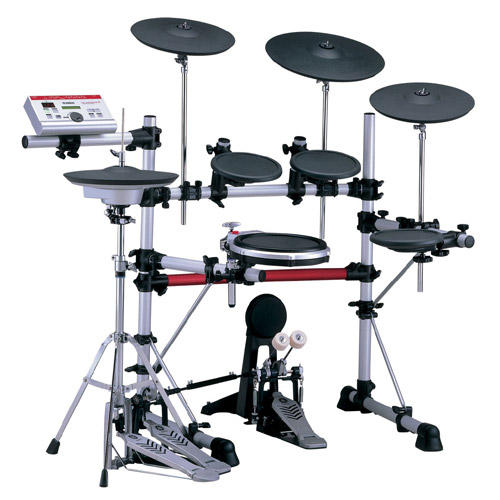
Hi Ed

OK, I have now spent many hours playing around with settings and
have managed to improve the kit.  The problem of missing sounds is
almost gone.

I experimented with the Rejection settings, the gain, and set the
pads to poly mode.

The main setting that made a difference was the rejection settings.
This took quite a bit of experimenting - if set very low solved my
problem but then I got double triggers instead - so I had to tweak
for a compromise.

Everything else about the kit (sound, feel etc) I think is great but
still don't really understand why this problem exists.

I really cannot see how changeing my drumming style will make a
difference.  For example I sat just hitting the Hi Hat and snare
together and the snare missed quite a few beats - I did the same
with a tom and the Hi Hat and the Tom then missed odd beats.

I notice that many people selling these kits on E-bay have built a
custom snare stand.  I guess this is so that they can turn the
rejection down to avoid missed snare beats but yet still not get
double triggers - does this make sense.  It must be a common problem.

I was wondering if the DTEXPRESS I is more prone to this than the
version II or III - has this problem been addressed.

Many thanks for your help.

Darrell
>
> Ed
Message
Re: DTEXPRESS Trigger Problem
2005-03-17 by daddykingcool
Attachments
- No local attachments were found for this message.