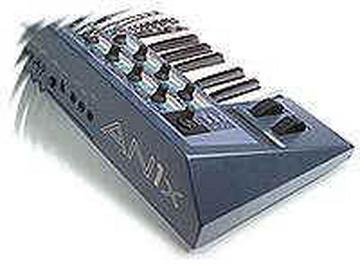
On Wednesday 31 December 2003 11:41 pm, Mike Metlay ++ Atomic City wrote:
> >Hi, everyone!  I've got a quick question regarding
> >mixer set-up.  So, here is the list of my equipment:
> >AN1x (obviously), ESQ-1, TX81Z, and an RY20.  Now, I
> >want to run these through a mixer (Alesis MultiMix 6x,
> >maybe), but on that specific model, it has 2 Mono
> >(lines 1&2) and 2 Stereo (lines 3/4 & 5/6) inputs.
> >Now, the question is, if I get this specific mixer,
> >what would be the best way to hook-up my gear?  I'm
> >sort of baffled as to why lines 3,4,5 & 6 don't have
> >their own separate stereo inputs. Shouldn't this be
> >labeled a '4 channel' instead of a '6 channel mixer',
> >as it effectively has "only" 4 sets of inputs?
> >Anyway, if someone would be so kind as to guide this
> >newbie down the correct path, I would GREATLY
> >appreciate it.  If you wish to reply off list, my main
> >e-mail addy is nsbhp5@.... Obviously just
> >remove the nospam from the address.  Thanks in
> >advance!
> >
> >Sincerely,
> >Scott
>
> Scott,
>
> Welcome to the jungle.
>
> The Alesis mixer you've chosen will not have enough inputs to run all
> of your gear at the same time if you want to use them all in stereo.
> Each box requires two inputs and that makes a total of eight.
>
> Mixer manufacturers can count the "number of channels" in many
> different ways; Alesis does it by counting the total number of
> signals that can be brought in on the channel inputs of the mixer (so
> a mono channel has one input and a stereo channel has two), but other
> manufacturers only count channel strips (thus possibly under-counting
> the number of inputs) or they also include effects returns (which
> over-counts the number of inputs).
>
> Most small mixers generally offer a combination of mono and stereo
> inputs. The former are for microphones and the latter are for the
> modern line-level keyboards that run in stereo, or for stereo effects
> processors (like the Line 6 POD) for guitars. The idea behind this is
> that if you're working with a lot of stereo devices, it's much easier
> and cheaper to build stereo channels for them. You only need one set
> of electronics rather than two, and when you turn down one knob you
> lower both channels' levels at the same time without riding two
> different controls. The ideal "synth mixer" would be a gigantic
> console that only or almost only has stereo channels, but only a few
> such boards have ever been made and they're only available as custom
> devices from companies like Speck Electronics now...and such boxes
> are very, very expensive.
>
> If what you want to record is four stereo instruments (I don't
> remember if the ESQ1 is stereo), you will require a mixer with four
> stereo channels or eight mono channels or some combination thereof to
> get you the total number of inputs you need. You will also need to
> reserve extra channels to use as effects returns if (a) your mixer
> doesn't have them and (b) you want to process your synths with
> external effects, for example a reverb box to help put all your
> synths in the same "room". If you're only going to use the internal
> effects of the Alesis mixer for now, then you needn't worry about
> that last limitation, as its internal DSP has its own returns and it
> doesn't use the ones on the mixer.
>
> If you insist on using the 6-channel Alesis, you'll need to do one of
> two things: either run two of your synths in mono, or use the stereo
> aux return to bring back one of your stereo signals into the mix
> (thereby sacrificing the ability to add external effects later). I
> recommend that you get the 8-channel model instead, as the extra few
> bucks will pay off in flexibility. And if you plan to add more synths
> later, you might even consider buying a mixer with even more channels
> to hold in reserve.
>
> Good luck, and if you really want to learn about this stuff upside
> down and backwards, the best investment you can make right now would
> be a subscription to a good pro audio magazine. I'd suggest
> --Whoops, ball dropping. Gotta go!
>
> mike