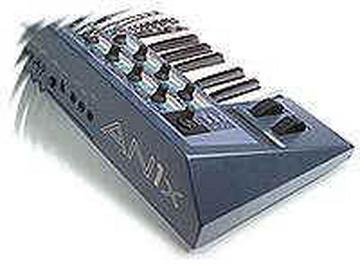
The Yamaha AN1x Synthesizer mailing list group photo

Yahoo Groups archive

The Yamaha AN1x Synthesizer mailing list

Index last updated: 2026-03-31 23:06 UTC

Thread

Re: [AN1x-list] "SCENES" & Re: Australia/Synthcompanies

Re: [AN1x-list] "SCENES" & Re: Australia/Synthcompanies

2000-07-31 by mango
And--Why do they call them "scenes"? Wouldn't "layer" be more appropriate?


"Layer" or "Channel1 / Channel 2" or "Timbre1 / Timbre2" ;) you can do various things with them "scenes"... why they called them "scenes" i dunno, but i found it a bit awkward too.

Re: [AN1x-list] "SCENES" & Re: Australia/Synthcompanies

2000-07-31 by Peter Korsten

From: "tspeer" <tspeer@...>

> Off topic part:
> Australia - "THE FAIRLIGHT"!!!!!!!!
>
> [...]
>
> I agree--Can't beat THE coolest Sampler of all time.

In this respect, it's interesting to read what Paul Wiffen, of the British
Sound On Sound magazine, had to say about the Fairlight:

"The Fairlight, inspiration from afar to a generation of electronic
musicians, was, once you got one in front of you, a load of old tosh, the
electronic equivalent of a kazoo, with all the musicality of a vacuum
cleaner. Whatever sound you put in, you got the same nasal honk out, and
trying to use it like a normal keyboard was the most frustrating thing I
ever did. I thought so the first time I heard/played one and nothing has
happened since to change my mind (I am of course referring to the pre-Series
III machines; the engineers at Fairlight would have been fools and
charlatans indeed if they couldn't have made the Series III sound decent and
play well after all the progress that had been made by other companies by
the time that machine came out...). I am referring to the pile of junk
marketed between 1979 and 1985. And when I say "the first time I heard one",
I mean really heard one, on its own, not buried in a production with all the
craft of experienced engineers and producers disguising its nasal honk. I
still vivedly remember Ken McAlpine, a former colleague of SOS Publisher Ian
gilby and myself at Electronics & Music Maker, sneaking me into the demo
room at Syca in 1983 to hear a Fairlight naked for the first time. I was
horriefied. Everything sounded like it was coming through a fuzzbox, and a
very cheap and nasty fuzzbox at that! I came away from that evening with a
profound sense of loss that the supposed greatest electronic musical
instrument was such a turkey (though it increased my admiration for all the
musicians and engineers who managed to make it sound so good on their
records). And sharing a booth with the original Emulator at a Parisshow a
few weeks later, where the demonstrator did mothing more than play the
Marseillaise on an out-of-tune trumpet over a maximum of two octaves, did
little to resurrect my faith in sampling."

Hey, he said it, not I. :)

Interesting to note, however, is that one friend of mine prefers the JP8000
sound over the AN1x, while the other one (who happens to have a shitload of
'real' analogue synths) is of the opposite opinion.

- Peter

Re:Fairlight/ An1x Vs. JP-8000

2000-07-31 by tspeer

> From: "Peter Korsten" <peterk@...>
> Reply-To: AN1x-list@egroups.com
> Date: Mon, 31 Jul 2000 23:44:41 +0200
> To: <AN1x-list@egroups.com>
> Subject: Re: [AN1x-list] "SCENES" & Re: Australia/Synthcompanies
>
> From: "tspeer" <tspeer@...>
>
>> Off topic part:
>> Australia - "THE FAIRLIGHT"!!!!!!!!
>>
>> [...]
>>
>> I agree--Can't beat THE coolest Sampler of all time.
>
> In this respect, it's interesting to read what Paul Wiffen, of the British
> Sound On Sound magazine, had to say about the Fairlight:
>
<snip>
>
> Hey, he said it, not I. :)

Granted- the OS may have been a dog- and the floppy was 10 inches (now
That's floppy), but the fact is- it sampled at 100Khz, and some of my
favorite artist's stuff was done on that sampler (Ministry's Twitch, &
Cabaret Voltaire's stuff).
It is widely known as the first Decent sounding sampler of the 80's- and
that's why it is nostalgically revered.

Show quoted textHide quoted text
>
> Interesting to note, however, is that one friend of mine prefers the JP8000
> sound over the AN1x, while the other one (who happens to have a shitload of
> 'real' analogue synths) is of the opposite opinion.
>
> - Peter

Hmmm... another comparison of a superior sounding instrument(An1x) to one
with a superior interface (JP-8000).

RE: [AN1x-list] "SCENES" & Re: Australia/Synthcompanies

2000-07-31 by Gary Gregson

>>
And--Why do they call them "scenes"? Wouldn't "layer" be more appropriate?
"Layer" or "Channel1 / Channel 2" or "Timbre1 / Timbre2" ;) you can do
various things with them "scenes"... why they called them "scenes" i dunno,
but i found it a bit awkward too.
<<

I think you've missed the point. The scene memories are not primarily
designed to provide bi-timrality or layering.

Specifically a scene is designed so that you can have variants of a voice
(note the scene holds more than just the sound formation parameters.....it
also contains the knob/control matrix settings!)

The idea is that you can have a single patch that provides two different
setups (think of it like scenes of a play where the stage set has been
re-arranged and different characters are interacting). Since there are only
a limited number of real-time controls on the keyboard, there may be times
(in a real-time performance) when you want to control a different set of
parameters for a voice.....or have the voice character change quickly. As we
all know, changing patches on the AN1x is painfully slow...it can take a
couple of seconds for the new patch to become playable. However using the
scene buttons you can instantaneously switch the voice and its control
configurations!

The fact that activating both scenes allows layering/key splits is just a
useful by-product. In fact the real reason they included the dual mode was
to allow subtle continuous morphing between the scenes!

Regards

Gary
Email:
gary@...
http://www.yme.co.uk/yme

Re:"SCENES" & Gary's Program & Knobs Vs. Sliders

2000-08-01 by tspeer

Gary-

Thanks for the explanation. My nord lead morphs between 2 sounds also-
but that's in a mode called "performance" not "scene".

I Love your AN1x edit program (Mac edition).

I really prefer sliders to knobs on synths and graphical editors.
I know synth companies have to choose one or the other (usually down to
cost)- but in my ideal dream world, graphical editor programs would give the
user the choice of an all sliders or all knobs screen.

I realize I should be punished severely for criticizing a FREE and
otherwise Excellent program- my apologies.

Todd:)

http://users.ev1.net/~xpander/SMCChome.html


Show quoted textHide quoted text
>
>>>
> And--Why do they call them "scenes"? Wouldn't "layer" be more appropriate?
> "Layer" or "Channel1 / Channel 2" or "Timbre1 / Timbre2" ;) you can do
> various things with them "scenes"... why they called them "scenes" i dunno,
> but i found it a bit awkward too.
> <<
>
> I think you've missed the point. The scene memories are not primarily
> designed to provide bi-timrality or layering.
>
> Specifically a scene is designed so that you can have variants of a voice
> (note the scene holds more than just the sound formation parameters.....it
> also contains the knob/control matrix settings!)
>
> The idea is that you can have a single patch that provides two different
> setups (think of it like scenes of a play where the stage set has been
> re-arranged and different characters are interacting). Since there are only
> a limited number of real-time controls on the keyboard, there may be times
> (in a real-time performance) when you want to control a different set of
> parameters for a voice.....or have the voice character change quickly. As we
> all know, changing patches on the AN1x is painfully slow...it can take a
> couple of seconds for the new patch to become playable. However using the
> scene buttons you can instantaneously switch the voice and its control
> configurations!
>
> The fact that activating both scenes allows layering/key splits is just a
> useful by-product. In fact the real reason they included the dual mode was
> to allow subtle continuous morphing between the scenes!
>
> Regards
>
> Gary
> Email:
> gary@...
> http://www.yme.co.uk/yme

RE: [AN1x-list] Re:"SCENES" & Gary's Program & Knobs Vs. Sliders

2000-08-02 by Gary Gregson

Todd wrote:
>>
I really prefer sliders to knobs on synths and graphical editors. I know
synth companies have to choose one or the other (usually down to cost)- but
in my ideal dream world, graphical editor programs would give the user the
choice of an all sliders or all knobs screen.
<<

Whether in the real world or in software....knobs are more efficient in
terms of the physical area occupied.

In both cases the widget is only there to graphically represent the position
of the parameter within its given range. (although in the real world there
are also tactile and ergonomic aspects to consider).

The 32 x 32 pixel knobs in An1xEdit have around 44 different graphical
states (although the parameters represented can be adjusted over a finer
range). The same size slider would be restricted to around 20 different
graphical states. Hence for the same screen area the knobs give a much more
detailed representation.

In operation the knobs of AN1xEdit actually behave like sliders. i.e. you
should move your mouse in a linear fashion (either up/down or left/right).
DO NOT try to move the mouse in a circle! Circular movements of a mouse are
very difficult to perform....so its a bad analogue for software to adopt.

You can also choose the polarity of the mouse movement using the Setup
menu/Reverse Dial action item.

You can get finer resolution by holding down the left and right mouse
buttons (CTRL+Mouse on MAC).

Or if you prefer the PC keyboard...just highlight the control and use the +
and - keys to increment/decrement the control. (A full set of keyboard
shortcuts are provided in the Help file appendix).

Also right mouse clicking (CTRL+mouse on Mac) resets a control to its
default value. Note the default state is defined by the Setup menu/Compare
to Defaults item. If this item is checked, then the defaults used are the AN
initialisation values. Otherwise the default is defined by the current
version of the patch stored in the library (i.e. the voice prior to any
edits).

Regards

Gary
Email:
gary@...
http://www.yme.co.uk/yme

Show quoted textHide quoted text
> -----Original Message-----
> From: tspeer [mailto:tspeer@...]
> Sent: 01 August 2000 22:58
> To: AN1x-list@egroups.com
> Subject: [AN1x-list] Re:"SCENES" & Gary's Program & Knobs Vs. Sliders