When recreating the sounds of the vintage synths like the Moog or
ARPs it may be helpful to remember that the waveforms from physical
oscillators often aren't perfect. They are sometimes a bit asymetrical
or the trailing/leading edges can be rounded. For example, one of the
older Moog Modular oscillators (901B) has a triangle wave that is
notched at the top edge.
VA and digital synths tend to create perfect waveshapes with sharp
edges. This is part of what produces the digital "sheen" in their
sound.
To more closely approximate an analog waveform, you may want to reduce
the edge parameter to about 100 to get the less than perfect tips of
the waves.
The feedback control (in moderation) will add some body to the sound.
Also, the EQ in the distortion/amp modeler can go a long way to
putting some beef in an anemic sounding wave before you actually
program the patch itself.
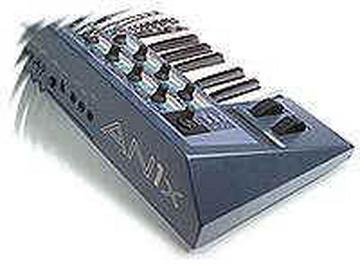
Finally, if you don't have a Minimoog or vintage sound to A/B the
AN1x with, you can download a demo copy of Arturia's Moog V or Moog
Modular V softsynths to compare your wave to.
You can listen to the Moog V (pretty good recreation) and tune
parameters on the AN1 like, feedback, filter cutoff, and EQ until you
get a reasonable representation of the Moogs waveform. It won't sound
the same, but if you get to know the AN1's parameters, you can get
pretty close.


Regards
Message
Re: the sound
2004-03-31 by marmaduke1012000
Attachments
- No local attachments were found for this message.