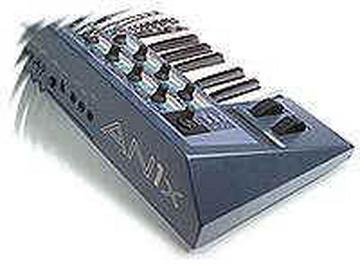
--- In AN1x-list@y..., "Jerry Aiyathurai" <tuskerfort@h...> wrote:
> I was hoping some of you might have some tips or pointers for me. I
> am trying to prepare a soprano saxophone patch on the AN1x.
Although
> I have access to other synths I would like to do this without
> resorting to the sax samples on my rompler, so that I can build in
> some of the modulation capability of the AN1X.
>
> Actually the sound I am trying to copy is an Electronic Wind
> Instrument sound that sounds kinda like a cross between an alto sax
> and a soprano sax with that puffy, reedy quality. I don't have to
> nail it, but I probably need to get better than I am getting which
is
> a brassy trumpet like tone. The trouble is the sound is going to
play
> with a brass section doing stabs and the like, so I really want to
> get some uniqueness of character for the synth.

The key is stop trying to create something that -sounds- like a sax
and start creating something that behaves like a sax. This is aways
the essence of phyical modelling. So start by thinking about the
modulators -

Remember a sax player sustains a note by blowing, not by holding down
a key. Blowing creates a very dynamic sound envelope which is not
simulatable using an ADSR envelope.

An envelope can do some work for you by creating the attack of the
note - but to get something that really sounds like a sax you have to
control the volume of the sustained phase by a physical controler
like aftertouch or the ribbon. This lets you simulate breath pressure.

Secondly a sax changes tone quite drastically as you move higher in
register - so set you filter to mimic this using note-number.

The tone of a sax is quite nasal, combined with some metalic
resonances. I would start with a pulse wave, and a band-pass filter.
Have the filter increase cut-off and resonance as note-number
increases. The resonance should get quite high for higher notes
(remember a high note is a high note for the sax - essentially a 2
octave instrument - not for you keyboard). Use a little plate reverb
to add some metal to the sound.

Lip pressure on the reed of the sax can bend the note by a semi-tone
or so. This is a feature of the instrument that players often use to
create effects like the classic strip-joint sax sound. Try to build
this into your "model" by having the pich bend set to +- 1/2 tone.

The pitching of notes by lip pressure implies that a sax is often
heard "bending into the note" during the attack phase and bending out
during the release - try setting up a rapid pitch envelope to do
this.

For extra realism, use another controler to add "lip" vibrato to the
note and one more to add in white noise for the breath sound that
sits under every note on the instrument.

Remember a sax is a monophonic instrument - so use your second hand
to manipulate the controlers. Even if the base sound is not so to say
photo-realistic - the ear is often more convinced by hearing the
typical playing idioms of the instrument than by an exact duplication
of its harmonic spectrum.


Aidan.
Message
Re: Wind instrument sound on an AN1x
2001-10-06 by Aidan
Attachments
- No local attachments were found for this message.