Hi and welcome to the list,

Yes, detuning the oscillators can make a 'fatter' sound. True VCOs (Voltage
Controlled Oscillators) are renowned for sounding 'fatter' due to slight
(pitch and even tonal) imperfections  when layered together. DCOs (Digitally
Controlled Oscillators) and those modelled by VAs are critiqued for not
fattening up when layered together as each oscillator is an exact clone of
the other.

A good analogy I like to use is here is imagine an oscillator to be a
playing card. When in Unison mode, you have a whole deck of cards stacked
together, but look down at the face of the top card, and you can still only
see (hear) the first one. Of course, it's closer (or louder) as it's layered
on top of the others.

That is where the the detuning comes into play, by shuffling up the cards
into a messy bundle. Gather them up into a pile and look at the top card and
you'll see (hear) all the other cards jutting out the sides - making the
pile look (sound) fatter overall.

As for how much detuning to use, it's a matter of taste. You're right, it
doesn't take much to make it sound out-of-tune. Another trick to fattening
up the sound is to use the 'Feedback' control (Knob#5 under the VCA group).
This also introduces an element of distortion so things sound stressed and
larger than life. From there, adjust the 'Edge' controls for each oscillator
(Knob#4 under the VCO1/VCO2 groups) to soften or brighten the tone by
warping the oscillator to and from a sine wave.

Need more fatness? Layering oscillators together that are spaced octaves
apart helps . Some synths have a dedicated 'sub' oscillator (set 1 or 2
octaves down) specifically for this purpose. To answer your question
regarding pitch shifting, one octave = 12 semitones. If you're stuck, count
the notes (white and black keys along the keyboard). Quite a popular
technique is to set the second oscillator to +7 (so that the note plays a
fifth).

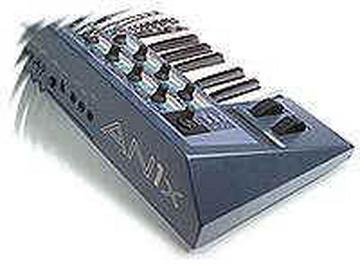
If things still aren't fat enough, switch the 'Layer' mode to 'Dual'. Now
you can use up to 4 oscillators together, as the AN1x effectively becomes
two synths in one. Switch between the two using the 'Scene 1' and 'Scene 2'
buttons. Use the low pass filter on one layer to make it into a sub bass
sound. Now you'll have the bass you can feel - combined with the bass you
can hear.

Hit Jon (on the list) for the link to the www.intermusic.com 'analogue
programming tutorial'. It's a terrific guide.

Hope this helps. Feel free to post back with any further questions you my
have.


Phil
--
  F U T U R E   M U S I C
   "Making Music at the
Cutting Edge of Technology"
   www.futuremusic.co.uk


From: omgemag@...
Reply-To: AN1x-list@yahoogroups.com
Date: Sat, 21 Jul 2001 03:40:56 -0000
To: AN1x-list@yahoogroups.com
Subject: [AN1x-list] Oscillator/Unison Detune


Hello,

I've recently purchased my first synth, the Yamaha AN1x.  I'm new to
analog synthesis and VA's so I've been reading many sites.  Several
sites I've come across mention detuning the VCOs to create a "fatter"
sound.

What is a good difference in the pitch setting to create the fatter
sound without making it out of tune (same goes with the unison detune
feature)?  Also, what pitch setting will transpose an oscillator one
octave above/below the other?  Any info about pitch is appreciated :)

TIA,
Forax


Community email addresses:
  Post message: AN1x-list@yahoogroups.com
  Subscribe:    AN1x-list-subscribe@yahoogroups.com
  Unsubscribe:  AN1x-list-unsubscribe@yahoogroups.com
  List owner:   AN1x-list-owner@yahoogroups.com

Shortcut URL to this page:
   http://groups.yahoo.com/group/AN1x-list


Your use of Yahoo! Groups is subject to http://docs.yahoo.com/info/terms/
Message
Re: [AN1x-list] Oscillator/Unison Detune (Also, Jon re: "Intermusic Programming Tutorial" link???)
2001-07-21 by Phil
Attachments
- No local attachments were found for this message.