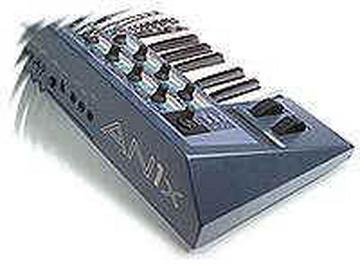
An1xers:

I must be having too much time on my hands. Yesterday I started
recording An1X oscillator tones and looking at waveforms. I also
started timing tests on LFO 1. I came up with the following table
which is pretty good up to three significant digits, I reckon.

Note that since the LFO's don't lock to anything, it would be a waste
of time using this table for synchronizing BPM. You would be best
served using this as a reference for programming vibrato, tremolo,
chiff, growl and other kinds of modulation things.


LFO 1 Setting	Rate (hz)
1	0.042
5	0.210
10	0.421
20	0.841
30	1.26
40	1.72
50	2.31
60	2.90
70	4.04
80	4.96
90	5.89
100	6.77
110	7.87
120	9.82
130	10.1
140	12.7
150	15.2
160	18.3
170	22.4
180	27.6
190	34.3
200	43.4
210	54.9
220	71.2
230	87.8
240	111
250	141
256	162

The waveforms were very interesting. I found a couple of surprises:

- All the waveforms were far more rounded than I expected even at an
edge of 127
- The pulse wave (at edge of 127) was more lopsided than I expected.
It had a sloping top line, looking more like a truncated saw, than a
square. (I guess they wanted to give us the possibility of more
overtones, should we need them.) I didn't play with pulse width,
though that is my next test.
- The saw, pulse, saw2 and mix waveforms, collapse to a pure sine
wave when edge goes to zero. The exception is the pulse wave under
oscillator sync, which collapses to sine only when edge is zero
AND sync pitch is minus 12. (I wonder if the slave is tuned up by an
octave, or something? why?)
- The internal (1,2,3) waveforms would not collapse to sine under any
circumstances. They appear (visually) to be stacked saw waves tuned
to the harmonic series. I am not sure specifically which overtones
they are tuned to, but I know it is not a simple octave relationship,
as I could not collapse them to sine by playing with the sync tuning
and edge. Each individual element would get more sine like, but not
the combined waveform.

My opinion:
I suspect (but I am not sure) that these are saw waves at an octave
above and 1.5 octaves above. The difference between the waveforms
(int1, int2, int3) lies in the relative volumes of the overtone waves.

I may be off base with these observations. I am hoping someone from
the list may have an inside scoop (Gary?), or has done more extensive
tests.

Anyway, I hope this info helps someone.

Cheers,

Jerry
Message
LFO rates and waveform shapes
2001-07-10 by Jerry Aiyathurai
Attachments
- No local attachments were found for this message.