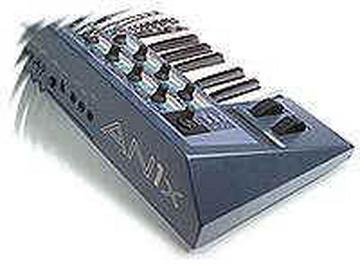
From: "Bj\ufffdrn Standal" <standal2000@...>

> Is there a reason for VA's to have less polyphony and timbrality than
> sampled-based synths? Even the new Supernova 2 only got eight part
> multitimbrality. It's just enough for basic songs, but I think 16 part
> multitimbrality is a minimum. Even my trusty DJX got that.

Polyphony and multitimbrality are two different issues. There's no real
reason why an instrument should have low multitimbrality: the first Access
Virus (the 'A') had 12 voice polyphony and 16 part multitimbrality.

For the Supernova, it would make sense to increase multitimbrality,
especially when you have the beefed-up 48 voice version. The Virus B fares
better in this respect, because it has 16 part multitimbrality.

As for polyphony, there's a pretty good reason for that. Contrary to what
most people on this list are claiming, there's not much of a difference
between the structure of a 'virtual analogue' synth and a sampling &
synthesis (S&S) synth. Both are substractive synths that have an oscillator
section, an amplifier section and a filter section.

It's not that the waveform is computed, because it's a look-up table in the
synth's ROM and therefore it doesn't differ from a so-called 'rompler'. All
samplers and 'romplers' have resonant filters, so that's the same as well.

The difference lies in the oscillator section, and in general how all
sections are computed. A synth nowadays is nothing more than a dedicated
computer, and it computes audio waveforms. In a VA synth, you have a simple
waveform, or two of them, but you can modulate them, change them, and have
them interact, all in real-time. This is the main difference with
sample-based synths, where the waveform is more elaborate, but fixed as
well. Computing interacting waveforms doesn't take that much computing time,
however.

The other difference is the computation of the sound. Real analogue synths
aren't perfect, and that is essential for how they sound. Whereas a digital
synth can produce a perfect 440 Hz tone, an analogue synth produces a tone
that hovers somewhere around 440 Hz. The same goes for the amplifier and the
filter. Computing all these small imperfections and having it sound
authentically requires the greatest computational resources.

> I extensively use MIDI (without being a guru, far from it), and in that
> sense the AN1X is near to useless in complete songmaking as I can only use
> one sound in every song. Sure there must be a way to at least use
different
> sounds in a track, albeit not at the same time? Is there something like a
> patch-change command I can send to my AN1X? I use Cakewalk 8.0.

Yes, it's called MIDI Program Change.

> Was wondering if I should invest in a sampler so I could sample my AN1X
and
> use it as a multitimbral AN1X-emulator. Don't know which sampler's got the
> best filters and effects, though... But that's a whole 'nother story.

There are loads of samplers. Generally, the more expensive, the better the
quality. A EMU E4 Platinum is a very nice sampler, but you'd have to
re-mortgage your house to afford one.

- Peter
Message
Re: [AN1x-list] Timbrality issue once more
2001-04-12 by Peter Korsten
Attachments
- No local attachments were found for this message.