Hi Dan !
welcome to the club ...
dan a écrit :
Unfortunately there is no dynamic allocation of the polyphony depending
on how and what you play, for ex. you have 5 notes on your left hand,
you play a single note bass line, that does not give you more than 5
notes on the right hand.
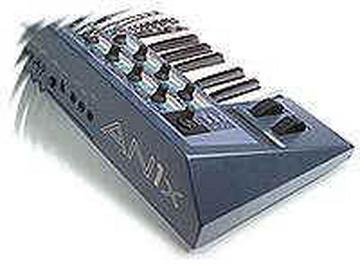
The AN1x keyboard has 3 modes : polyphonic, legato (2 notes max.) and
mono, as a lot of synths.
Legato and mono are useful to emulate huge monosynths of yesterdays
while soloing with some weird synth patch with the right one, and you
have both patches somewhere in your synth or your computer. Copy each
one to one "scene" of some empty or useless memory , and it's done. Then
you can split the keyboard as you want.
arpeggiator can be assigned to the right or left part of the keyboard at
will. If i remember well the 2 "scenes" share the same MIDI channel number.
other...to the other, and set the split point where you want (default
C3). Or even swap them.
One interesting feature with these "scenes", plus the split - layer
possibility, is to "morph" between both scenes once you've assigned the
"morphing" to the mod wheel. It's not a simple sound balance between 2
layers but a progressive change of the sound parameters from one to the
other, giving sometimes weird sounds in between with synth patches. I've
found it very useful for organ patches to travel between a rock organ
and a more jazzy sound, a bit like you can do with the drawbars.
OK, 10 note polyphony is sometimes not enough, but not so often ...
Remember of the 5 or 6 note polyphony of the vintage Prophet, Jupiter
and other analog polys of old the AN1x was intended to emulate. It does
the job...
Yamaha had issued a great but underrated instrument. Sometimes i regret
they've not made an "AN2x" with more polyphony, knobs ...but with the
same sound engine. Surely Yamaha's marketing department has decided that
the big business was not there, leaving it to others.
J.F.
welcome to the club ...
dan a écrit :
>That's true : either 10 notes on "single" patches or 5 + 5.
> Hi, i'm interested in buying this fantastic synth, and i read that
> AN1x got 2 parts with 5 + 5 notes.
>
Unfortunately there is no dynamic allocation of the polyphony depending
on how and what you play, for ex. you have 5 notes on your left hand,
you play a single note bass line, that does not give you more than 5
notes on the right hand.
The AN1x keyboard has 3 modes : polyphonic, legato (2 notes max.) and
mono, as a lot of synths.
Legato and mono are useful to emulate huge monosynths of yesterdays
>Yes . For ex. you want to play "strings" chords with your left hand
> I would like to know if:
> - i can use 2 completely different patches
>
while soloing with some weird synth patch with the right one, and you
have both patches somewhere in your synth or your computer. Copy each
one to one "scene" of some empty or useless memory , and it's done. Then
you can split the keyboard as you want.
>I'm afraid not, but i've never tried it. The internal sequencer or
> - i can sequence these 2 parts with 2 midi channels
>
arpeggiator can be assigned to the right or left part of the keyboard at
will. If i remember well the 2 "scenes" share the same MIDI channel number.
>Yes. You can assign one scene to the right part of the keyboard, and the
> - i can easily split and assign these parts to the keyboard
>
other...to the other, and set the split point where you want (default
C3). Or even swap them.
One interesting feature with these "scenes", plus the split - layer
possibility, is to "morph" between both scenes once you've assigned the
"morphing" to the mod wheel. It's not a simple sound balance between 2
layers but a progressive change of the sound parameters from one to the
other, giving sometimes weird sounds in between with synth patches. I've
found it very useful for organ patches to travel between a rock organ
and a more jazzy sound, a bit like you can do with the drawbars.
OK, 10 note polyphony is sometimes not enough, but not so often ...
Remember of the 5 or 6 note polyphony of the vintage Prophet, Jupiter
and other analog polys of old the AN1x was intended to emulate. It does
the job...
Yamaha had issued a great but underrated instrument. Sometimes i regret
they've not made an "AN2x" with more polyphony, knobs ...but with the
same sound engine. Surely Yamaha's marketing department has decided that
the big business was not there, leaving it to others.
>Cheers.
> thanks
>
> dan
>
J.F.
>
>
>