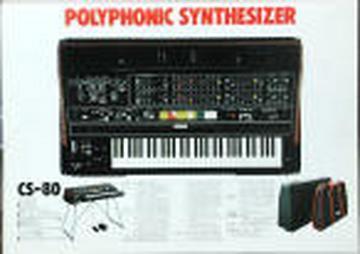
I had a yamaha CS70m (Digitally controlled Analog)and It had alot of
these features that P5 was hot on.....the eg in vco and multiple
instances of lfo in different areas.......It was programable....with
seperate storage presets for mix one and mix 2 two (BTW the mix 1
defined the footage of the two mixes and whether mix 2 was a modulator
of mix one or just a regular mix.....)the six oscillators per mix could
be split into key halves.....two/four or four/two each calling on
individual presets...and there was an Omni mode making one hell of a fat
dual/mono synth..There were 16 storage points in each mix row and two
panel...thus the two mix rows lended to a combination of 256 plus
sounds...There also was a booklet of dual bank magneto strips which one
could save and load single presets and bank presets....the two filter
(Hpf Lpf) was reduced to the American single filter but had 3
modes....lowpass....bandpass....highpass.....On the back was a blue
rectangle connector which allowed connectivety to other Yamaha CS
instruments...(precurser to midi)...PolyAT was gone....reduced to
channel-aftertouch which was applied by a single pressure
point(seemingly hardwired across all the keys....very annoying in the
key bed)Velocity and portamento/glissando changed from the KAS
perspective and so did the Ring modulation as it was assignable as to
what it effected.....[Image]
The CS80 with its limited programibility is by far the better keyboard
and CS70m which Americanised the Yamaha people thus churning out
Prophets and raking in "profits" was born.....programability won over
musicality.........and the rest of us were left with a hollowness only a
CS80 could fill...............
Mert Topel wrote:
> Hi Stephen,
> Although it is impossible not to agree what you say, I d like to add
> two points:
>
> You can not edit the sound of an acoustic instrument but instead,
> inorder to get your sphesific sound out of it, you customize your
> playing.
> So, eventhough some fancy modulations are not present on the CS
> series, the expression possibilites open up many musical possibilites.
>
> I believe that the US and Yamaha approaches are two different
> approaches so synthesizer music. Maybe I am too much addicted to
> responsive synthesiers like the DX7 and the VL1. So, realtime
> expression power means a lot to me.
>
> I try to overcome the lack of autotune by altering the footage on my
> CS80 when the tuning gets unpleasant. Not quite like the MKS-80 or P5
> autotune but it helps up to a degree.
>
>
> --- In yamahacs80@yahoogroups.com, "Wavecomputer360"
> <wavecomputer360@...> wrote:
> >
> > Hi Mert,
> >
> > > Have you got any idea why the great CS60 was not popular ever?
> With
> > > it's monophonic aftertouch, initial velocity, lovely ribbon
> > > controller , ring modulator and 8 polyphony, it should at least
> be a
> > > tough competitor against the Prophet 5.
> >
> > It never was, just because when compared with a P5 the CS60 sounds
> extremely
> > thin, and it reveals its appeal on second sight only. With all its
> > idiosyncratic terminology on the envelopes, the rather under-
> achieving
> > filters, and its more "Japanese" sound it had no chance to woo
> potential P5
> > buyers who were accustomed to Mini Moogs and ARP Odysseys most of
> the time.
> > The P5 came up with that "American" sound which the CS60 just
> couldn´t do.
> > And you mustn´t forget that Yamaha had no real reputation for
> building
> > synthesisers at that time, people were rather suspicious of
> something called
> > "combo synthesiser", especially when their first encounters with
> > synthesisers bearing a "Yamaha" tag were the SY-1 or SY-2 (which
> are no bad
> > instruments, but a little flimsy when compared with its competitors
> from the
> > USofA). Even the GX-1 was passed off as an Electone organ, and this
> type of
> > poor marketing coupled with initially not very convincing sounds
> certainly
> > added to the fact that Yamaha didn´t have much success with their
> > synthesisers ∗before∗ they put out the CS80.
> >
> > >
> > > I have owned a P5 for about 9 years and although it sounds
> interesting
> > > and powerful, the rough pitch and modulation wheels, rather poor
> > > keyboard and lack of velocity and aftertouch makes the precise
> > > controlling of musical expression quite impossible.
> >
> > That´s right, but at that time it was exactly what people needed.
> Not to
> > forget its biggest selling asset was its programmability. 40
> patches versus
> > one on the CS60? Apart from that, people were used to Moog-style
> wheels, and
> > like Richard Luebbing once put it "people like Chick Corea were
> used to the
> > Moog wheels, so off went the ribbon controller". That´s marketing.
> Read the
> > "Vintage Synthesizers" review of the CS80 in Mark Vail´s book, it´s
> indeed
> > very enlightening.
> >
> > And it's limited
> > > polyphony makes the P5 a real looser against the CS60 at
> sustaining
> > > sounds. To me the P5 is not as musical compared to the CS60/80
> >
> > I would replace "musical" with "organic" and I´d subscribe to your
> view.
> > Curtis- or SSM-based synthesisers tend to have a less animated
> sound because
> > they are more stable and more "phase-locked" while the CS60 or CS80
> benefit
> > enormously from each oscillator card going its own way. Which might
> lead to
> > a minor reliability issue or two...
> >
> > >
> > > The mighty CS80 makes the CS60 look a small limited synthesizer.
> But if
> > > we take the CS60 on it's own, it is an incredible synthesizer
> still.
> >
> > Definitely. But we should bear in mind that both CS60 ∗and∗ CS80
> are pretty
> > limited when compared to a Prophet 5 or an Oberheim OB-Xa in terms
> of
> > modulation and such. No VCO sync, no PWM through the EGs, no
> Polymodulation,
> > no unison mode, no autotune, no RAM memories. The CSs excel at
> expression,
> > richness of tone, and performance power but not in timbral variety.
> Like
> > Brian Eno once put it, "the CS80 has just six sounds on it, but
> these are
> > gorgeous".
> >
> > >
> > > I am a lucky owner of a CS80. The CS60 is going to be my next
> purchase
> > > with it's easier portability for my stage performance.
> >
> > Agreed, and the CS60 seems to be less temperamental when it comes
> to tuning
> > stability, probably because the internal cooling is more effective
> as there
> > are less components installed.
> >
> > >
> > > BTW, I old my P5 last summer and never miss it.
> >
> > I´d miss it, I know that, as they are both like apples and
> oranges :-). One
> > can do tricks the other can´t do. And I for one would love to add a
> Rev. 3
> > P5 to my setup some day or other. Just like I´d love to add an
> Oberheim Four
> > Voice to it someday...
> >
> > Stephen.
> >
> > >
> > >
> > >
> > >
> > >
> > >
> > >
> > > Yahoo! Groups Links
> > >
> > >
> > >
> > >
> > >
> > >
> > >
> > ____________________________________________________________________
>
> >
> > "Ambition makes you look pretty ugly." (Thom Yorke/Radiohead --
> "Paranoid
> > Android")
> >
> >
> > Now available: "Tektonik" and "Gronland", two new ambient music
> albums by
> > Stephen Parsick.
> > Each album is limited to 25 copies and will come in a special
> packing and is
> > hand-numbered.
> >
> > It´s out: "doombient.two -- a declaration of war", the new [´ramp]
> album,
> > recorded live in 2003.
> > Limited to 100 copies only so get it while you still can.
> >
> > For info and audio, please visit the official [´ramp] website at
> > www.doombient.com
> >
>
>
>
>
>
>
> SPONSORED LINKS
>
Music sampler Unit Sampler
> -----------------------------------------------------------------------
> YAHOO! GROUPS LINKS
>
> + Visit your group "yamahacs80" on the web.
>
> + To unsubscribe from this group, send an email to:
> yamahacs80-unsubscribe@yahoogroups.com
>
> + Your use of Yahoo! Groups is subject to the Yahoo! Terms of
> Service.
>
> -----------------------------------------------------------------------
>
[Non-text portions of this message have been removed]