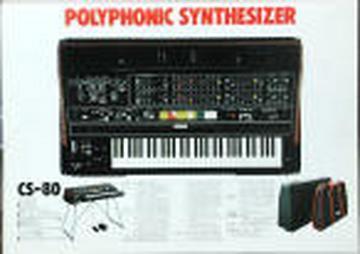
So last night I took a look at the KAS board of my ailing CS60.
I checked the line of resisters near IC1, none of them seemed to be
touching against each other, but there is some dust in there. I
checked the pins underneath and didn't see any obvious signs of a
short. When I screwed the KAS board back down and closed the case and
turned the CS60 back on the problem with the wrong notes seemed to fix
itself!
Then I noticed that the Sustain I-II switch seems to be not working
properly. It appears to be stuck on sustain II mode (I press one note
with sustain turned up, it sustains, I press another, the sustain of
the first one cuts out, this happens at both position I and II of the
sustain switch), so I opened the panel again to see if there was a
loose wire on the switch. There doesn't seem to be, however
unfortunately when I closed the front panel again my original problem
with the wrong notes being triggered has started again. :/
Also, I noticed, when I have the release on the VCA envelope turned
on, when I play a few notes at the same time, their attack rate isn't
the same: I have the attack set to zero, yet some notes fade in as if
the attack rate was set up for that particular voice. When the release
is set to zero (and the attack rate still set to zero) and I play a
chord, all the notes sound at the same time as they should. Perhaps
this is just a voice calibration problem though?
So first things first, there is a bit of dust and debris in there I'd
like to get rid of, how would one normally go about cleaning the dust
out of these things? Spray some canned air in there? That may be the
cause of the wrong note triggering problem (or a loose wire, seeing as
when I moved the KAS board it seemed to fix it), once I fix that I can
take a look at the sustain button problem and the VCA envelope release
problem.
Thanks for all the information and help so far, unfortunately I'm a
complete novice when it comes to electrical repairs, but am not afraid
to give it a go. I'm thinking of investing in an oscilloscope anyway,
any recommendations?
-Stephen
On Wed, Jun 18, 2008 at 9:50 AM, skkatter <skkatter@...> wrote:
> Thanks for all the detailed suggestions! I'll be getting back down to
> the studio today to perform some further investigations, I'll keep you
> updated!
>
> -Stephen
>
> On Tue, Jun 17, 2008 at 5:51 AM, Kyle Jarger <jkjelec@...> wrote:
>> Hi All,
>>
>> The note assignment table shows the note output in relation to the N1
>> through N4 signals. The table shows N1 through N4, but IC1 on the KAS board
>> actually puts out the inverse of these signals, /N1 through /N4. It looks
>> like you will get the "wrong note pattern" you are showing in the case where
>> /N2 and /N3 are somehow shorted together, such that if any one of them is
>> high, it wins the battle and pulls the other one up as well. It looks like
>> the ouptuts of IC1 each have a 22K pull-down resistor, so it makes sense
>> that if two signals were shorted, the high level would win the battle (the
>> high output being actively driven by the IC, the low level being only
>> passively pulled down by the resistor). My first guess is that two of the
>> 22K resistors running along the side of IC1 in a "vertical mount"
>> configuration have shorted together, as one resistor has leaned over as
>> result of the shipping movement, such that the exposed leads of the resistor
>> are shorting out to the lead of the next resistor over. If this is the
>> case, it should be visually apparent when looking at the KAS board. A
>> simple readjustment of the resistor position to get rid of the short should
>> fix the problem.
>>
>> If that disn't work, I'd use an ohmmeter (between pins 26 and 27 of IC1 on
>> the KAS board) to see if there is a dead short between /N2 and /N3. If there
>> is, maybe you can find a small piece of metal that fell between the pins of
>> an IC, or on the PC board, from the movement during shipment. I'd check the
>> bottom of the PCB baord as well, for bent pins or an errant piece of metal.
>>
>> If its not a dead short between the pins, then it is likely one of the ICs
>> is bad. In my experience its usually the CMOS support ICs that have failed,
>> not the custom yamaha ICs, and so I would replace IC4, a TC4050 chip, first.
>> Even though this chip only has /N2 and /N3 as INPUTs, not Outputs, I recall
>> that in some cases a failure in the chips can actually affect signals that
>> are only inputs to the chips. If this doesn't do it, I fear its one of the
>> Yamaha custom IC's, IC1 or IC2.
>>
>> Good Luck!
>>
>> Kyle Jarger
>>
>>> octave, when I press c, c#, d, f#, g, g# they all play fine.
>>>
>>> However when I play the other notes they do the following:
>>>
>>> I press d#, I hear a c#
>>> I press e, I hear a c#
>>> press f, I hear a d
>>> press a, I hear a g
>>> press a#, I hear a g
>>> press b I hear a g#
>>
>>
>
>
>
> --
> http://www.skkatter.net
>
--
http://www.skkatter.net