Interesting. Do you mind if I add this message to the VCA page as
constructors notes?
Ken
>I recently completed construction and initial testing of the VCA
>using a 1SH24B tube. I built it in MOTM-format using a panel and
>bracket from Bridechamber.
>
>The version I built is different than the original circuit. In order
>to avoid damaging the PCB from excessive unsoldering, I did not build
>a stock unmodified version for comparison purposes.
>
> From what others had said, there were three issues: the output was
>noisy, there was a "high-pass effect" or "loss of bass", and there
>was a "thump" during the attack of the EG when used as a VCA. So I
>modified the circuit in order to reduce noise and increase bandwidth.
>
>LED's are very noisy. Since the cathode is in the signal path, I
>eliminated the two signal diodes, the two LED's, and their resistors.
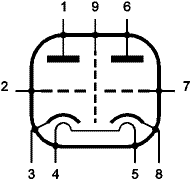
>I connected a 1.2K 1/2W resistor between Pin 1 of the cathode-heater
>and ground.
>
>I was out of TL072's. In order to use a fast op-amp (which would not
>be an LM358 or LT1013) to drive the grid capacitor that was better
>suited for audio, I replaced it with an OP275. The OP275 requires
>power bypassing to operate within specification, and the stock 100nF
>bypass caps are too far away to be effective. Also, the stock 100nF
>cap on the positive looks like it forms ~15kHz LPF on the tube
>output. So I eliminated those caps, and underneath the PCB, added
>two .1uF ceramic caps with heat shrink tubing going from ground, with
>the capacitors as close as possible to the power pins on the socket.
>The OP275 can drive capacitive loads, and works better as a
>non-inverting amp if the parallel value of the gain resistors are
>less than 2K. So eliminated the 47pF cap on the output, and replaced
>it with a resistor lead. I did not add the gain resistor. While 330
>Ohm is the minimum specified resistor for output protection, I
>replaced it with 1K (outside the feedback path) to have the same
>output impedance as MOTM.
>
>The grid capacitor forms a high-pass filter with the (330K) grid
>resistor in parallel with the grid resistance of the tube. The grid
>resistance of the 1SH24B is specified as 100K. So the resulting
>corner frequency with a 220nF cap would be 9.4Hz -- not high enough
>to cause a problem, imho. However that specification is when the
>cathode-heater is run off 1.2V, which is not what we are doing here,
>so therefore the grid resistance is unknown. So I increased the two
>220nF caps to 470nF (both of them so the tube would still sit level :)
>
>At audio frequencies, the effective impedance of the plate is the
>plate resistor (8K2) in parallel with the load resistor (100K).
>Imho, coupling caps sound better driving lower impedances. So I
>changed the plate resistor to 20K and the load resistor (connected to
>pin 5 of the OP275) to 33K. 20K||33K = 12.5K yielding a bit more
>gain than the stock circuit.
>
>However, I do not think the "high-pass effect" noticed by others was
>largely due to the coupling caps. I think it was due to cathode
>depletion -- negative feedback that increases with lower frequencies.
>So I added a cathode bypass capacitor. I could not figure out a way
>to derive an appropriate value mathematically. So I used a 47uF
>axial electrolytic. Which may be way larger than necessary, and also
>might not sound as good as a film cap, YMMV. I connected it between
>pin 2 of the tube (connected to the negative rail) and ground. Do
>not connect it to the ground side of the cathode or the in-rush
>current could burn out the heater.
>
>I wired up the bias switch -- using properly shielded cable -- to two
>settings: 330K towards the negative rail, and 1M towards ground.
>They sound a bit different from each other, but more on that below.
>
>I hooked it up and started testing it. I didn't notice any noise on
>the output. While distortion increases the high frequency content, I
>did not notice a "loss of bass". As one would expect, the output
>does roll off at low frequencies eventually, but this seems to occur
>below the audio range. While distortion increases with input level,
>it does not reach the point where it squares up completely.
>
>With the CV INIT trimmed, and no CV input, the output of pin 7 of the
>LM358 is +6V with the gain control potted all the way down, and
>-14.38V with the gain potted all the way up, the output of pin 1 is
>-12.1V and 13.77V respectively. The Gain knob (I used a linear 50K
>pot) has no effect within the last tick or so as it runs into the
>rails. The output level seems fine.
>
>With the stock 100nF cap installed, I did not notice a click or thump
>when driving it with an MOTM-800 EG. So far, with a minimum attack,
>it seems better than the MOTM-190 in that regard. However, there is
>a noticeable peak or boost in output at the beginning of the
>envelope. Which seems like a nice feature, and it it is easily
>reduced by increasing the length of the attack. While the resulting
>curve seems neither perfectly linear or exponential, it is easily
>adjusted by ear. Although considering the range of the gain pot,
>I'll try decreasing the CV input resistor to 50K. So besides that,
>and given the distortion, it works fine as a "regular" VCA.
>
>With a roughly 10Vpp source, distortion becomes obvious when the
>input is more than half-way up (I used linear 50K pots for both audio
>inputs). While the sound is quite different when using either
>positive or negative feedback (and imho, changing Input 2 to a
>reversing attenuator would be a nice mod), between the two bias
>settings, the difference without feedback is subtle. There is also a
>slight effect on the CV response between the two settings.
>
>I'm still trying to figure out the best way to wire the bias switch.
>I would like one setting to have the least distortion possible, and
>another to have more distortion available.
>
>With no signal, the voltage on the grid measures -14.66V connected to
>the negative rail with a 330K resistor. With the signal grid
>connected to ground with a 1M resistor, when first powered up when
>already warm, it reads -13.50V then slowly climbs to -14.16V and
>stays there. Switching between the two switches between -14.66V and
>-14.16V.
>
>I checked all my connections. My conclusion is that the grid is
>capacitively coupled to the -15V cathode. Keep in mind that this
>tube was designed to run the cathode near ground, and the grid biased
>a bit below that.
>
>With a signal, the negative voltage on the grid increases. If I
>measure 3.15 VAC rms (about 9Vpp) on pin 1 of the OP275, with the
>grid connected to the negative rail with a 330K resistor, the grid
>measures -17.85 VDC. Which is roughly equal to 14.66 plus 3.15.
>Well, anyway, at least the grid is negative to the cathode, which I
>guess is kind of normal :)
>
>Luckily, it doesn't become so negative it that it cuts off the plate
>current. Still, I would like to figure out the optimal bias
>settings. Although I was planning the resistor towards ground as the
>clean setting, the slightly more negative (.5V) setting has less
>distortion. So while there isn't much wiggle room, I'm going to try
>reducing the 330K resistor for less distortion. Beyond that, my only
>other idea is to make the cathode less negative. I'm also going to
>try decreasing the 1M for more distortion.
>
>If some of you who have this module could measure the cathode and
>grid voltages that would be appreciated.
>
>
>Thanks :)
>
>
>
>
>
>
>
>
>
>
>
>
>
>
>
>
>
>
>
>
>
>------------------------------------
>
>Yahoo! Groups Links
>
>
>
>
_______________________________________________________________________
Ken Stone
sasami@...Modular Synth PCBs for sale <
http://www.cgs.synth.net/>
Australian Miniature Horses & Ponies <
http://www.blaze.net.au/~sasami/>