I concur with Thomas and Martin.
I have been able to cite these on my own different instruments (2 Chamberlins and 3 Mellotrons - a study in itself) and there is definitely a difference but whether it's better or not depends on what you want to use it for.
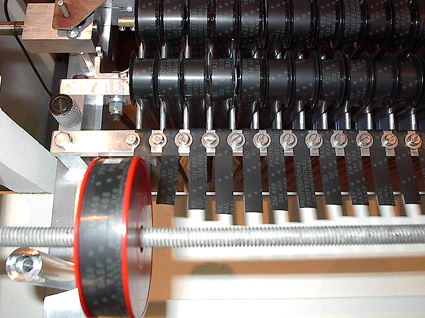
The Chamberlin was built to exactly replicate whatever was recorded on the tape. So, when you play a Chamberlin, you're going to hear a clear and bright sound and also very much the ambience of the room it was recorded in. They used Neumann U47's almost exclusively and Harry had built a special room for recording sounds. The sound - because of it's brightness - and placement of the mic, is easily mistaken for the real instrument in a mix. Unless you have a Chamberlin that you can hear those sounds from, you might not recognize the sound unless you play it like an organ - full chords.
This was by design. It was meant to play big band standards on. That idea is captured in the way the recordings play when you press a key.
The Mellotron can sound much lush and fuller in the mid range, and perhaps more distinctive because of the way the tapes were mixed down and also because there is slightly more wow and flutter in the Mellotron tape travel system. This is what adds to the beauty of the machine. There is a lot more going on with the Mellotron sound than the Chamberlin. The beauty of the Chamberlin is simplicity. The Mellotron is that same simplicity taken further into another realm perhaps.
To my ears the Chamberlin doesn't sound like a Mellotron and the Mellotron doesn't sound like a Chamberlin. Even Chamberlin recordings on Mellotron tapes don't sound like a Chamberlin at all to me. It's almost like the difference between MKII, M300 strings and the M400 strings. I would imagine that would be true if Mellotron sounds were put on to Chamberlin tape as well. I've found this is true of the Birotron and Optical disk keyboards as well.
All of them have their own sweet spot not captured by the others.
There's different sound sources and different octave ranges as well. The Chamberlin Cello is one octave higher than the Mellotron Cello for example.
It's also down to different pre-amp systems and slightly different physics involved when the tape mechanism plays.
Ahh, the beauty of mechanics!
On Sun, May 22, 2011 at 7:44 PM, Thomas C. Doncourt
<tomdcour@amnh.org> wrote:
I can compare form an M1 and an M400 on the cello and 3 violins. I can't
say which I like better though... the M1 is brighter in both cases but the
M400 seems fuller. Two slightly different sounding instruments but each
with its purpose. The M1 sounds better to me with the tone control nearly
all the way up - the M400 I have the tone at less than half.
> I would be interested to hear I direct comparison of the 3 violins played
> on an M400 and a Chamberlin, has anybody on the list got a working
> Chamberlin, did Mattias sort his out?
>
> Mark
> --- In
newmellotrongroup@yahoogroups.com, tronbros <tronbros@...> wrote:
>>
>> Maybe different but not better. The M400 is capable of hifi quality if
>> given good source material. It is not the muffled lofi beast everyone
>> assumes. We have put excellent commercial recordings through them and
>> they handle up to 16k, clear and precisely. Never underestimate the
>> potential of a mellotron.
>>
>> Best,
>>
>> M
>>
>>
mellotronics.co.uk>>
>>
>>
>> On 22 May 2011, at 00:32, "markpringnz" <markpringnz@...> wrote:
>>
>> > Would these sound a lot different played through a chamberlin? I would
>> guess that they would.
>>
>
>
>