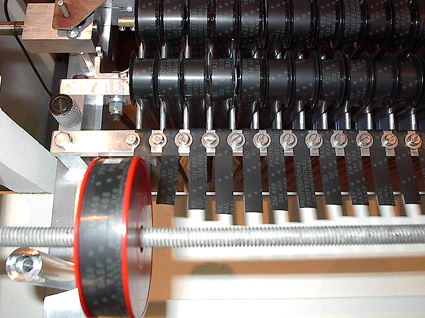
Hi all- Interesting point, this "Mellotronized" quality you speak of, Frank. I have been turning this over in my mind, too. Why do the older sounds have a different quality than the new ones? Why has the aspect of "just another sampled sound" cropped up in this discussion? Modern recording techniques are usually entirely in the digital domain these days. No knocking it, it is cost and time efficient, and accurate. If processing is needed, there are no real anomalies with a high enough sample rate. Correct me if I am wrong, but new sounds probably stay digital until they are recorded on the Mellotron frame tape. So, in many ways the new recordings are essentially a digital sample, save one step. All playback anomalies are from the 'tron itself. Think about the tape-to-tape stages used in the early recordings. Maybe something like this for an M400 frame: Master tape of sound recorded. Safety copy(s) made, and used for further production Copy of safety copy made for editing down to proper sequence (maybe timed, possible splicing done) Copied to production master, producing 3 different sounds side-by side Safety production master made Your copy from the safety production master. Now, imagine the possible tape generational losses involved for a single sound from 5 generations of tape copying. Even more was involved if, say, a mix like the MK2 Brass was produced. Think of the complexity of making a MK2 tape set itself ! (can you say "Mothertron"?) There are probably holes in my logic on this (especially if 4- and 8- channel multitrack machines were employed, which would've been a boon for producing early mixes and sequences). The audio engineers back in the day really busted their balls to make sure the copies were as good as possible. However, the generational tape losses had to contribute to that "tronny" sound. Some of those early production qualities still come through in the vintage sounds, as their source is tape. Is this the sound we are seeking? Is this the difference between the old and new sounds that is currently vexing us in this thread? Great discussion! -Bruce Daily, Tapehead --- On Sun, 11/7/10, lsf5275@aol.com <lsf5275@aol.com> wrote:
From: lsf5275@aol.com <lsf5275@aol.com> Subject: Re: [newmellotrongroup] Re: New Sounds In General To: newmellotrongroup@yahoogroups.com Date: Sunday, November 7, 2010, 2:50 PM
I think the gist of all this is simple. The new sounds don't sound like the old sounds. Because they aren't. They still get "Mellotronized," each in their own way, and distinct from machine to machine. There. That sums it all up and nothing more needs to be said. That is the definitive summary that will satisfy everyone so we're done with it.  Frank In a message dated 11/7/2010 12:31:11 P.M. Eastern Standard Time, rick@rickblechta.com writes: I think a lot of this discussion is based around the current list's owners' nostalgia for their youth. "I want to relive the glory years of prog rock when I couldn't afford one of these things!" Now we have the money to indulge ourselves in the same way that a 50-year-old goes out and buys an old Jaguar. I personally would be bored musically with 3-violins, brass, choir and cello (which were the most popular sounds way back when. To say that the "Orchestra" sound is made up of old components, and then blow it off for that reason is completely missing the point. Les did something wonderful when he put it together. To be fair, I love playing "Watcher of the Skies" as much as the next old fart.
The reason the old library of sounds is so dodgy is that they were recorded badly by people who weren't adept musicians (the people recording, not the people playing, necessarily). That brass sound is ridiculous if you break it down into its 3 discreet com ponents -- which is how it was recorded. That's its downfall (but also its charm). Lots of horn bands use trumpet, trombone and tenor sax. Do they sound like the MkII brass? Of course not. If Les and the guys had recorded these three instruments playing together at the same time, the results would have been far different (and probably a lot more in tune!).
My reasons for recording new sounds was primarily to make some new ones available (bass clarinet, bari sax, bass flute, etc) but also to fix up some of the bad ones that I really wanted to use but couldn't (French horn, oboe, clarinet). The reason many of these new ones don't "sound like a mellotron" is because of our list members' expectations still being mired in the past.
What's the median age of the members of the list? I'll bet it's mid-50s. Of course there's a natural urge to hang onto our youth. I'd like to give a few M4000s to some good, creative young bands and see what they could come up with since they're (hopefully) not mired in the '70s. I think we'd all be surprised with what they'd come up with. Would we think it sounds like a mellotron? Perhaps yes, perhaps no -- but they would. Actually, that's what Streetly is doing and there have been some excellent results.
Is anyone here aware of the fact that the precursor to the mellotron was the pipe organ? Take a look at what many of the ranks on them are called: oboe, clarinet, flute, trumpet, etc. In trying to make an instrument that could imitate these instruments, organ makers came up with a wholly new instrument that sort of sounded like them. I've heard mellotrons described as tape transport organs, and that is what they are. I still maintain that any instrument recording put on an 8-second piece of tape and mounted on a mellotron will sort of sound like that instrument, but in going through the instrument, it will become so mething different. Vive la difference! Those who say the new voices don't sound like a mellotron haven't played them.
Rick
|