birminboy said:
> Hi -
>
> I'm very glad this list exists, so thanks in advance for my "newbie"
> question:
> [...]
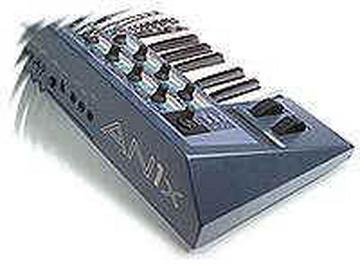
> ∗ By slaving the AN1x to a Korg ER-1, I can get the sequences and
> arpeggios to play in sync. But only after re-"storing" each sound so
> that external MIDI is the default tempo. Is this really what everyone
> who uses the AN1x with a drum machine has to do?
I believe so. It's rather frustrating, but it's how Yamaha chose to do things.
> In short, all I really want to be able to do is sync the AN1x
> arp/sequencer patterns to a drum machine, and at the same time use
> the keyboard to play notes on the AN200 as a synth module.
Steve, I don't know if what you want to do is possible, and unfortunately I
don't have my AN1x in front of me to test my theories. Let me explain, and I'm
sure Jon or Bruce or someone will jump in to confirm or deny what I have to
say:
There's a MIDI control setting on most devices that can make sounds and
control other devices, called Local Control. It can be on or off. When local
is on, the keyboard plays the internal sounds and the data from the keyboard
is also sent out to other modules. When local is off, an external controller
can be used to control the sounds inside the keyboard, and the keyboard
controls other modules without firing its own sounds. Okay so far?
Now, where things get gnarly is when you put an arpeggiator in the loop.
(Excuse me if I get professorial here for a bit; I've consulted with a fair
number of companies on arpeggiator design... ;)
The arpeggiator is one of the most misunderstood devices in the world of
electronic music. On the surface, it seems trivially simple and people always
wonder why it "never works the way I want it to"; in fact, under the hood,
they're very complex devices and require a number of design compromises that
can't always be reconciled.
An arpeggiator, in order to operate, requires three things: a source for
timing data (which includes start and stop commands), a source for note input
data, and a destination for arpeggiation data. When an arpeggiator is built
into a self-contained keyboard like the AN1x, this is about as straightforward
as it gets, especially when operating in monotimbral mode (i.e. without splits
or layering).
Things get complex when a device becomes multitimbral: which layers get
arpeggiated, which ones follow the key presses alone, and which ones ignore
the whole thing? When you add in external MIDI networking, the problems
explode out of control: where does timing data come from? How is arpeggiation
data transmitted, and where? Is the actual keypress data of the keyboard
available as a separate control stream, or is it permanently mingled with the
arpeggiation?
Local off solves some of these problems while creating others. The problem is,
when you draw the line through the architecture of the synth and say,
"Everything on THIS side of the line is part of the control keyboard and
doesn't affect the innards" and "Everything on THAT side of the line is part
of the sound engine and only listens to MIDI input", where does the
arpeggiator fall?
If it falls on the "keyboard controller" side of the line, then you can't use
your keyboard to just play external modules, because when the arpeggiator's
on, the keyboard makes external modules arpeggiate. If it falls on the "sound
module" side of the line, then the arpeggiator operates fine but has to be fed
note data from ANOTHER keyboard somewhere else. And it's possible for timing
data to "cross the line" on some designs, letting an arpeggiator on the
controller side still sync to clocks coming in on the module side.
Don't denigrate your MAX too quickly just for being old; Sequential has always
been dynamite at arpeggiator design and integration. The Prophet VS had one of
the best, most playable arpeggiators in history, long before the AN1x came
along. By contrast, Yamaha is very new at the arpeggiator game; I haven't put
a lot of thought to it but I'm hard pressed to think of any Yamaha board that
had one, before the AN1x and its cousins the CS1x and CS2x.
What you need to investigate, by trial and error if nothing else, is what
happens to your AN1x's arpeggiator and sequencer when Local Control is turned
Off. Clock the AN1x from your Electribe and hook the AN1x's MIDI out to the
AN200, and experiment with clocking and activating sequences and arpeggios.
Soon you'll figure out where you have a disconnect.
Solutions to these problems are legion, but they involve a little bit of
money, a little bit of strategizing, and access to tools that used to be
everywhere in the era of MIDI but are now much more rare: mergers,
channelizers/filters, etc. Once you figure out where clocks and notes come and
go in a Local Off situation, I can make a suggestion or two as to how to get
your system to work the way you wish. Others may beat me to it.
mike
--
Mirai: "I predict in the future all music will be made and heard with
organic living technology..."
Rothwell: "You mean musicians?"
> < > < > < > < > < > < > < > < > < > < > < > < > < > < > < > < > < > <
metlay / atomic city /
metlay@... /
http://www.atomiccity.com