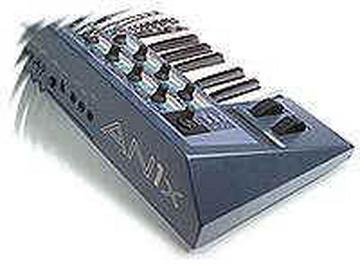
OK, some more useful data, I hope. Most of this is "IMO"-tagged; I've been
working with the Xpander for almost 20 years and the AN1x for about ten
months, so there's a disparity in my expertise. So noted...
xpander said:
> AN1x: faster envelopes.
> AN1x: more "sterile" FM - but more consistent across the keyboard.
These are true, but the former much more than the latter. If you tune the
Xpander and let it settle in, FM actually behaves very nicely over a very wide
range of pitches. Remember, it's real analog, and operating temperature has an
effect on this stuff, although in my experience nowhere near as much as with
other analog gear of this vintage.
The slow envelope attacks on the Xpander are, for most people, its Achilles
heel, and the AN1x is much snappier out of the starting gate. Pardon the pun.
> Xpander/M12: warmer low end (VCOs)
I think that the overall sound quality of the Xpander goes way beyond "warmer
low end" in comparison to the AN1x. The filters are smoother and richer, the
FM has a lot more character, the modulation capabilities beat the AN1x in
several areas (although with 32 routings over two scenes plus the common ones,
the AN1x stands up better against the Xpander than almost any other synth out
there from the early 1980s until the release of the Nord Modular in 1999), and
the all-analog audio path has a sweet tone that the AN1x can't match.
> Better interface and "look"(graphics) on the Oberheims (What the hell
> was Yamaha thinking with those horrible brown colors ?)
I would have liked more contrast, yes, but the Oberheim is actually very hard
to read under low light conditions. Fortunately everything is done with VFDs
and soft knobs, so once you've memorized where the Page buttons are you can do
almost everything by feel.
> Of course the Oberheims have no Ring Mod/effects/etc.....
And you can add that easily enough with external boxes and it'll sound way
better than the tweezy internal effects on the AN1x, even if you buy a
movice-level modern multieffector like the Alesis Ineko.
> IMHO- The AN1x sounds great - and holds its own against the old Obie &
> Roland Poly/Analogs (for most applications).
That last parenthetical statement forgives a lot, but I have to protest a bit
here.
The Yamaha is an okay analog modeler for its era (late 1990s, when this stuff
was just becoming feasible in affordable quantities) but it doesn't compare
well to even a more modern model, like the Access Virus C or the Novation
Supernova II, much less a real analog synth like the Xpander or Matrix-12.
It is true that every synth has things it's good at; the AN1x is an excellent
synth for suggesting analog-type sounds while remaining portable, reliable,
tightly tuned, and appropriately integrated with effects and performance aids
like the sequencer, arpeggiator, and Free EG. But in my explorations so far,
including listening to many patches done by very creative people, I have yet
to hear an analog-simulation patch that knocks me on my tail and makes me say
"Whooaaaa...!".
And the Xpander hasn't ever been immune to criticism, I should point out. When
the Xpander came out, it was derided as too complicated for the average knob
twiddler, too expensive for the average beginner, too tightly-tuned to compare
to "real" analog boards like the Minimoog and OBXa (even Tom Oberheim says the
Xa was the last "good sounding" synth Oberheim made), and too much of an
all-things-to-all-people box to be convenient (most everyone wanted CVs or
MIDI, not both, and a huge box with no keyboard was considered a waste of
space). Nevertheless it's stood the test of time quite proudly and is still
cranking out phenomenal sounds nearly 20 years after its release.
The AN1x deserves its props, to be sure, but let's see where it is when it's
almost old enough to buy beer.
mike
--
Yes, I'm an agent of darkness, but I do more on salary than commission.
> < > < > < > < > < > < > < > < > < > < > < > < > < > < > < > < > < > <
metlay / atomic city /
metlay@... /
http://www.atomiccity.com