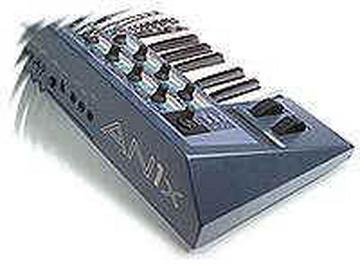
Archive of the former Yahoo!Groups mailing list: The Yamaha AN1x Synthesizer mailing list

previous by date index next by date
previous in topic topic list  

Subject: RE: [AN1x] re: was new owner

From: Bruce Wahler <bruce@...>
Date: 2003-03-04

Hi Bob,

>I need to disagree just a little. I am sure that some of you use filters for
>your patches - isn't that just eq by another name? Keeping patches "dry" is
>just making it a different patch from the one that was eq'd.

You're technically correct: A filter is a form of EQ. However, in the synth world a filter is rarely a static entity; instead, it changes over the course of the notes being played. EQ, on the other hand, is a broad brush that affects the entire sound.

There's nothing really wrong with EQ per se. It's just that heavy amounts of EQ can change the way a certain sound sits in the mix. If you look at the "classic" synths -- the Minimoog, the ARP Odyssey, the Putney VCS-3, the Prophet Five, the Roland Jupiter 8, etc. -- none of them had bass and treble controls. If EQ was needed, it was provided after the fact -- but strangely enough, EQ wasn't needed all that often! The raw sound of a sawtooth or pulse wave has a "thickness" that can get lost when heavily EQ'ed.

I look at EQ as similar to heavy doses of volume. On one level, increasing the amount of volume (or treble, etc.) can pull an instrument out of the shadows. However, it may lead to needing to do the same thing to other tracks, and once you "make everything louder than everything else," to paraphrase an unknown member of Deep Purple -- Ritchie Blackmore, perhaps? -- you have again lost the distinctness of individual instruments, only this time the bar has been raised and the entire timbre of the sound is changed. The same effect happens when you process every track through a Sonic Maximizer or an Aural Exciter: The sonic "advantage" added by processing a track gets lost when every track is processed the same way.

Effects, EQ, and aural processing all have their place in the musical toolbox, but there is a danger of each of these tools becoming a crutch to use when out of ideas. I'm a firm believer in the less-is-more approach. Start with a raw sound, and if it doesn't suit your purpose, THEN add EQ and effects to change the sound. You might be surprised at how seldom the extra processing is really needed.

Regards,

-BW

--
Bruce Wahler
Ashby Solutions™ http://music.ashbysolutions.com
978.386.7389 voice/fax
bruce@...