RJ,
>Would someone like to write a tutorial on the osc sync? I've fooled
>around with it and got some interesting metallic sounds, but I really
>don't know what I'm doing. What are some good settings? What happens
>when you sync the oscillators? What's a good way to modulate the
>sounds?
Oscillator sync causes the slave oscillator to always restart at the beginning of the master oscillator's wave cycle. Let's use, as an example, two VCOs, one (the master) at 500Hz and the other (the slave) at 1200Hz. The second VCO will produce almost three times as many cycles per second, but every time the 500Hz oscillator reaches the start/end of its cycle, the 1200Hz oscillator will be forced to reset, too. This means that the slave VCO's timbre will have harmonics related to both its "native" frequency (1200Hz) and the sync frequency (500Hz) imposed on it.
This in of itself is an interesting electronic effect, but relatively boring, timbre-wise. What's needed to make the effect more interesting is to have the slave VCO's frequency change over time, compared to the master VCO, which is relatively constant. Once this happens, the sync effect will create a constantly changing spectrum of frequencies, yet still produce a dominant note, based on the master oscillator. The result is similar to the result when the muscles of the throat and face modulate the output of the human vocal chords during speech (and singing).
Classic examples of oscillator sync in action are The Tubes' "TV Is King," Split Enz' "I Got You," and No Doubt's "Just A Girl." In all three cases, the second oscillator's pitch is being modulated by an envelope generator; usually, the one that modulates the VCF. In most cases, the sync EG is set to a long attack and decay, while the VCA EG is set to a more organ-like envelope (fast attack, high level of sustain or very long decay).
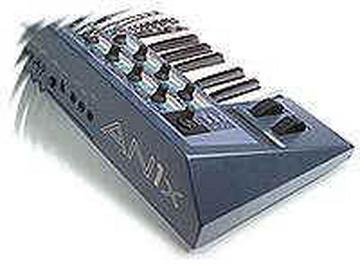
Other useful sync modulation sources are the LFO, the mod wheel, the key number (very subtle), and in the case of the AN1x, the Free EG. Another interesting modulator is the ribbon controller, which can be used to make the synth "talk" by quickly stabbing at and sliding along the ribbon.
Regards,
-BW
--
Bruce Wahler
Design Consultant
Ashby Solutions™
http://design.ashbysolutions.comCloneWheel Support Group and HiNote moderator
978.386.7389 voice/fax
bruce@...