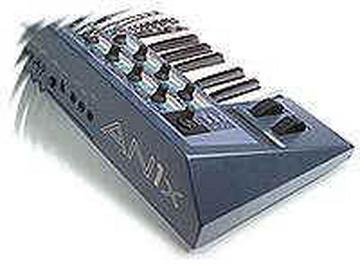
Archive of the former Yahoo!Groups mailing list: The Yamaha AN1x Synthesizer mailing list
Subject: Re: USB - any good as a MIDI port interface?
From: jondl@...
Date: 2001-01-06
Hello Marlon,
--- In AN1x-list@egroups.com, Marlon Jürs <M.Juers@w...> wrote:
> Hi there!
> I got exactly the same problem as Chris. I still hesitate from
buying an
> USB-MIDI-Interface. Because of it's described timing and
bandwidth-problems.
>
> Now I heard about the "great" new USB-Midex 8x8-MIDI-Interface from
> Steinberg wich offers a new technology called LTB-protocol
which means: no
> more timing problems. Could this be true with USB? Is'nt still the
serial
> port much more accurate than USB? Does anyone of you have made any
own
> experiences with it or can tell me, where I can read tests or
comparisons
> about it. Please help!!!
There are a couple of things to keep in mind with the latest crop of
MIDI Interfaces. First of all, Steinberg's LTB protocol is
proprietary to their hardware/software combination just as
Emagic's AMT
protocol and MOTU's MTS protocol are to their hardware/software
combo's. In other words, even though you could use an Emagic AMT8
or
Unitor as a standard MIDI Interface with Steinberg Cubase it would
not
provide the LTB functionality. The same is true for using the new
Steingberg interface with Emagic Logic Audio - the AMT feature would
not work. This may be a non-issue for many users. On the plus side -
some of the current MIDI Interfaces offer both USB and
Serial/Parallel
port connections for Mac/PCs (Emagic, MIDIMAN, & MOTU each do.) Cool.
I've always been inclined to use same make of MIDI Interfaces as
my
software. I had very few significant problems with this approach up
until I downsized my MIDI rig and switched sw apps but that's
another
story...
Unless you're running a large MIDI rig - say eight (or more)
multitimbral MIDI modules - you may not notice any benefit from
these timing enhancement protocols. MIDI is a serial protocol, i.e.,
one message sequentially following another. The inherent latency in
the
MIDI signal over a serial connection may not be noticeable when
running 1 - 3 devices, or maybe even 4 - 5 devices, but once you get
up
to 6 - 8 you're likely to encounter what is affectionately termed
"MIDI Slop" on the latter devices in your MIDI chain.
Protocols such as
AMT, or LTB, or MTS do not work by `speeding things up' but
rather
through a sophisticated caching scheme where in the data is delivered
across multiple ports/channels simultaneously. This is of great
advantage in a medium to large MIDI rig but the potential benefits
could still be inhibited by the limitations of the receiving device
and
how you use it. For example, say you use a sampler that offers
internal
effects but using the effects are DSP intensive, i.e., "more
better"
sound quality at the expense of MIDI response time to Note events.
Assuming you are as intimately familiar with every piece of gear in
your rig as most musicians ;-) you've probably sworn off using
the
sampler in our example as a multitimbral sound module - well, using
AMT
or LTB or whatever is NOT going to change or improve matters. It will
not alter the native latency of your device(s) - just deliver the
goods
on time, that's all. That said, most modern MIDI instruments have
a
response time significantly better your average VSTi so the example
may
not be as common as it was 5 - 10 years ago.
If you'd like to discuss the pros & cons of USB MIDI Interfaces
further please contact me offline so we don't carry on with an "off
topic" for too long in front of the entire list :-) I'd be happy to
share my experiences with you. If you do a search of the list archive
you'll find some related posts from last year too.
Hope this helps.
Regards,
Jon