From: "Gary Gregson" <
gary@...>
> Peter wrote:
>
> >>
> There's no way you can compare the DB50XG, or any of the MU series, to the
> EX5 (or S80 and CS6x, as far as I'm aware).
> <<
>
> Actually they are all based around the same chipsets and all use AWM2. The
> major differences are the numbers of chips provided, the samples and the
> level/modes of access to the parameters.
I would imagine that the number of chips, especially those responsible for
envelopes, filters and the like make quite a bit of a difference.
> >>
> The thing with these XG tone generators is that they aren't programmable.
> You have voices, and you can play a bit with filter cut-off and resonance,
> plus the amplitude EG, but that's it. Voice #1 will always be a piano.
> <<
>
> You can do considerably more than that with an XG device. (what about
> tuning, LFO settings, EQ, voice layering and of course the effects!)
However
> in the end they conform to a standard....hence the voice map is fixed.
Response of filter to keyboard velocity is something I don't see in my
DB50XG - admitted, not the top end of the XG range. But that's just one of
the things lacking in XG (at least, the XG I know from my DB50XG and what I
saw in XGEdit).
But the idea of a patch, meaning your own sound, is alien to XG. And I think
that differs it from a 'real' synth: one that you can actually program. You
can't program XG, you can only tweak it.
> Its an essential trade off between compatibility and flexibility! In other
> words the lower level AWM2 editing parameters are masked from the user and
> the sample set is fixed.
I know XG can sound pretty good. Still, I don't think it qualifies as a
synthesiser - more as an electronic sound generator.
Another synth which has superior synth qualities to XG is the Korg Triton,
and yet it is GM compatible. XG is a trade-off of features against price.
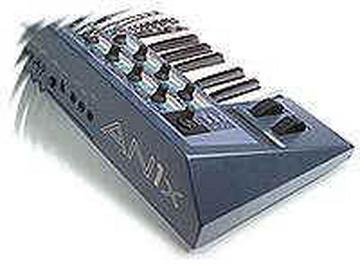
> >>The AN1x is far superior to XG tone generators
>
> Chalk and cheese....the devices are designed for different jobs. They also
> use fundamentally different methods of synthesis. AN1x isn't much use for
> playing back multipart MIDI files with high poly. XG isn't much use for
> expressive analogue synthesis or bottom up sound design!
The only difference is the oscillator, or oscillators. After that, you get
the filter stage and the amplifier stage. A classic substractive design if
you ask me.
> >>
> I'm not sure if this is the case. The Rolands compress their samples for
> sure - something I'm not in favour of. I'm positive that the samples in
the
> EX5 are uncompressed.
> <<
>
> Almost all synths manufacturers compress the samples! Otherwise you would
> end up requiring huge ROMs for the voice sets. The EX5 is no exception.
I looked it up in the EX5 service manual and the thing has four 32 Mbit wave
ROMs (and four 8 Mbit OS ROMs), which makes for 16 Mb of uncompressed
samples. Since the specs say that it indeed has 16 Mb of wave data and not
32 Mb, it's uncompressed.
I told you I was positive. :)
- Peter