Nah... that's over-simplification. A properly working keyboard is all dependant on relationships. It's not just how fast you can play it, it's about consistency. Does each key played maximize the sound of the tape passing under it? Is there consistency in volume and EQ from note to note? When blending tracks, does the blend sound similar from note to note? Example: Blending strings and cello... a little more cello than strings on this key... a little more strings than cello on the next, and so on, all over the keyboard.
It is possible to not only get an incredibly light action, but incredible presence and consistency from note to note, track by track, to the maximum capability of the recorded tape if the keyboard is set up exactly right. This is very subjective and the formula you show below is a compromise.
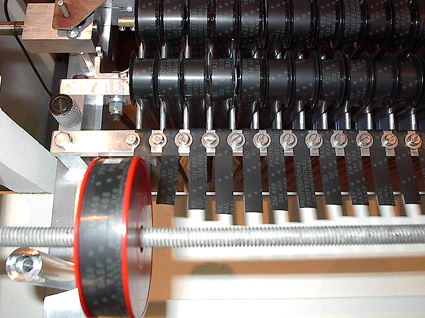
Even changing frames can change playability. Different frames often have different amounts of friction in the 35 individual tape paths, due to spring tension, whether the turnbuckles are set up correctly and how much they rub against the separators, how well the plastic rollers spin, etc. It's all about friction, friction, friction.
That leads me to pinch rollers. New ones are far superior to old ones. They grab the tape with less pressure. Pressure pads with good felt, properly aligned to the heads require less pressure. Friction, friction, friction.
So here's a simple formula to get the most out of every frame. You need enough roller pressure on each key to pull the tape all the way to the end without loss of pitch. No more... no less. You need enough pressure from the pad (once properly aligned to the head) such that when a key is depressed, as the tape moves progressively forward, consistency of volume is maintained for the full time the key is depressed.
As the tape gets pulled forward, the return spring tension increases. Especially near the end, as the turnbuckles approach the limits of their travel, tape tension is going to tend to lift the pressure pad a bit, causing loss of volume and clarity, The objective, therefore is to only apply enough pressure pad adjustment to keep that pad against the head until the tape is at the end. No more, no less.
Making these adjustments means going back and forth a bit setting pad and corresponding roller tension for each key.
These adjustments are ENTIRELY subjective, although less so on a Mellotron that has been properly set up by an expert. When I work on a machine, for me the keyboard and head block are the heart and soul of the machine. Power supplies, motors and preamps are easier. Component values and performance aren't subjective... they are measured. Keyboard setup takes hours of work. Head azimuths must be set first. When they re right, then you can match the pads to the heads.
You want your Mellotron to sound and play great? Perfect it. But remember. Friction is the enemy. The less, the better, The less you need to pull the tape, the better. Old pinch rollers can not be "reconditioned". Buying new ones is one of the very best investments you can make.
It's all about relationships.
Frank
In a message dated 3/19/2013 12:26:18 P.M. Eastern Daylight Time, tron400@yahoo.com writes:
Following is the method I learned from Jerry K and Ken L recently (for M400's only!).
DISCLAIMER: This is what I remember with the remainder of my aging brain cells. If I've missed anything or something is unclear or illogical, please correct.
1. Carefully remove the L-shaped stop bar over the keys.
2. Adjust the hex nuts at the rear of each key so that all the keys float evenly and not too high.
3. Replace the stop bar.
Then for each key:
1. Back off the pinch roller and pad screw until there is no sound and no tape movement.
2. Adjust the pinch roller screw until the tape just starts to move (remove the back panel so you can see the tape movement).
3. Adjust the pad screw until sound appears.
4. Adjust the pinch roller screw until the tape stalls, then turn the screw 1.5 turns clockwise.
5. Adjust the pad screw until there is no sound, then turn the screw 3/4 turn clockwise.
4. Repeat steps 4 and 5.
After following this procedure, I can easily and effortlessly do a glissando across the keyboard.
Bernie
--- In newmellotrongroup@yahoogroups.com, Bruce Daily <pocotron@...> wrote:
>
> Ummm....  Little purple pills?
> Â
> Â
> Â -Bruce D.
> Â #1221
>
>
> ________________________________
> From: matthew meixner <ccstickleback@...>
> To: "newmellotrongroup@yahoogroups.comnewmellotrongroup@yahoogroups.com>
> Sent: Monday, March 18, 2013 11:43 AM
> Subject: Re: [newmellotrongroup] re: New Video with Mellotron Mk. VI
>
>
> Â
>
> Hi gang,
> Â
> What is this method for improving action?Â
> Â
> Matt
>
>
> ________________________________
> From: "lsf5275@..." <lsf5275@...>
> To: newmellotrongroup@yahoogroups.com
> Sent: Monday, March 18, 2013 12:31 PM
> Subject: Re: [newmellotrongroup] re: New Video with Mellotron Mk. VI
>
> Â
> Well, I'm happy I could do at least something to help.
>
> In a message dated 3/18/2013 12:38:31 P.M. Eastern Daylight Time,
> rjtr2958@... writes:
> Â
> >Thanks Frank.
> >Â
> >It's only fair to add that the fact that I was able to play that relatively fast lead line on the Mk. VI and it sounded ok was due to your tips on improving the action.
> >Â
> >Thanks again.
> >Â
> >Rick
> >
> >
> >
> >________________________________
> >From: "lsf5275@..." <lsf5275@...>
> >To: newmellotrongroup@yahoogroups.com
> >Sent: Sunday, March 17, 2013 11:37 PM
> >Subject: Re: [newmellotrongroup] re: New Video with Mellotron Mk. VI
> >
> >Â
> >Really nice Rick!
> >
> >Frank
> >
> >In a message dated 3/17/2013 1:24:22 P.M. Eastern Daylight Time, rjtr2958@... writes:
> >http://www.youtube.com/watch?v=-QotLuE0rPs
>